Which Small-Parcel Consolidation Tool Should I Buy? A Scenario Checklist for International Shipping

Table of Contents
If you are asking which small-parcel consolidation tool I should buy, you are not looking for a "best brand." You are trying to prevent one of the most common cross-border mistakes: choosing a workflow that looks cheap at checkout, only to become expensive after repacking, storage days, billable-weight rules, or exceptions.
This article gives you a scenario checklist you can use to evaluate any provider or platform. It focuses on objective decision drivers: billable weight, timing, parcel proof, repacking control, restricted-category handling, tracking quality, and how fast problems get resolved.
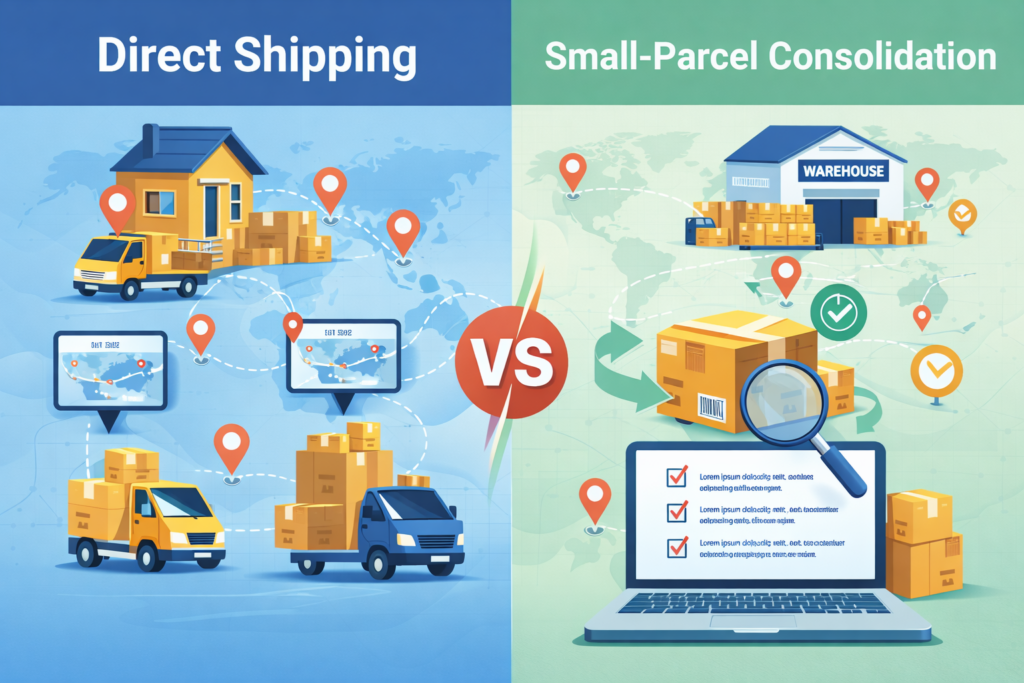
What are you really deciding when you ask, "Which small-parcel consolidation tool should I buy?"
The real decision is where you "pay for complexity."
- With consolidation, complexity lives inside the warehouse (receiving, sorting, repacking, batching, dispatch).
- With direct shipping, complexity lives at your doorstep (multiple deliveries, multiple tracking numbers, scattered arrival days).
The "right tool" is the one that matches your primary constraint:
- Lowest landed cost (with predictable rules)
- Faster delivery
- Lower damage risk
- Cleaner customs workflow
- Fewer delivery events and fewer tracking issues
If you do not pick a primary constraint, deciding which small-parcel consolidation tool to buy becomes a subjective debate rather than a practical choice.
When does consolidation vs direct shipping matter most?
It matters most when you buy from multiple Chinese sellers, each with a different shipping timeline and packaging quality.
Consolidation decisions become high impact when:
- You have 3+ parcels in one buying cycle
- Seller packaging is bulky (DIM risk is high)
- Items are mixed (soft goods + fragile items)
- You want one delivery instead of many
- You want predictable proof and tracking milestones
If you typically buy only one item from a single seller, you can still consolidate-but the ROI is often lower.
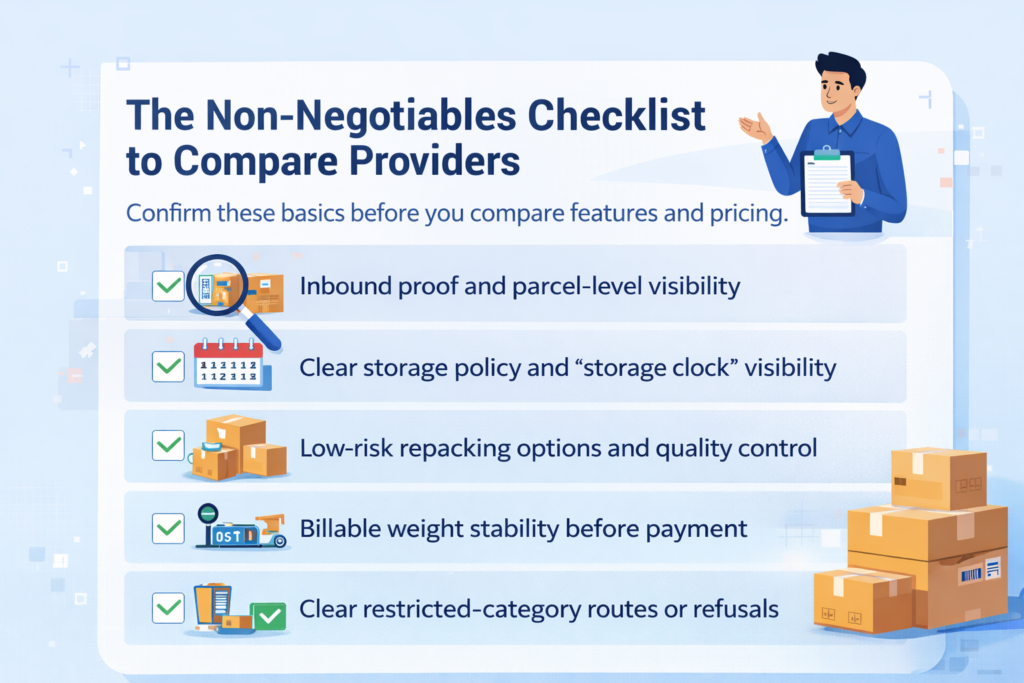
The non-negotiables checklist before you compare providers
Before you compare features and pricing, confirm these basics. A provider that fails multiple items below is rarely the answer to the question, "Which small-parcel consolidation tool should I buy?"
1) Inbound receiving proof and parcel-level visibility
Minimum expectations:
- Each parcel is scanned when received (not days later)
- You can see parcel status changes (received → stored → processed → shipped)
- The provider can map parcels to your orders (or at least to a clear parcel ID)
Why it matters: Without inbound proof, missing-parcel disputes are slow and difficult to resolve.
2) Storage policy clarity (and a visible "storage clock")
You want clear answers to:
- When does the free storage window start? (arrival vs check-in)
- Are free days calendar days or business days?
- What happens if one parcel arrives late?
- Can you ship partial or batch shipments without friction?
If storage rules are vague, your total cost becomes unpredictable.
3) Repacking controls that reduce volume without raising risk
"Repacking" should not mean "make it smaller at any cost." It should mean controlled options:
- Remove outer boxes (when safe)
- Right-size cartons to reduce wasted air
- Add protection by item type (soft goods vs fragile)
- Separate heavy from delicate items
- Provide optional photos for verification
A strong repacking process is one of the most reliable ways to cut costs on DIM-heavy routes.
4) Billable weight transparency before payment
For international shipping, many carriers charge the greater of:
- Actual weight (scale weight)
- Dimensional/volumetric weight (based on carton size)
A serious provider should show you estimated or measured:
- Weight
- Dimensions
- Billable weight logic (actual vs DIM)
- The shipping line's pricing tier impact
If you cannot see billable weight drivers, the small-parcel consolidation tool you buy remains uncertain until after you pay.
5) Restricted-category handling (or apparent refusal)
Some categories require special routing based on destination and carrier rules (for example, batteries, liquids, aerosols, and magnets). What you want is clarity:
- Supported categories per route, or
- An apparent refusal of a safe alternative (ship separately, different line)
Ambiguity here is not just a cost risk-it is a delay and seizure risk.
A scenario checklist that answers which small-parcel consolidation tool should I buy
Use the scenario that most closely matches your actual buying pattern. Then prioritize the matching tool capabilities.
Scenario A: Multi-seller Taobao/1688 buying with 3+ parcels
Your main problems are operational friction and billable-weight waste.
Choose a tool that is strong at:
- Repacking to reduce volume (DIM control)
- Parcel mapping and inbound proof
- Batch shipping rules (ship what arrived, don't wait forever)
- Clear total fee breakdown (warehouse services vs shipping)
This is the scenario where consolidation typically wins-if repacking is done well.
Scenario B: E-commerce seller shipping internationally (repeatable operations)
Your main problem is consistency. You need predictable outcomes, not "best effort."
Prioritize:
- Workflow discipline (receiving SLA, processing time visibility)
- Tracking quality and notification milestones
- Clean documentation workflow for customs
- Support responsiveness for exceptions
In this scenario, the best answer to the question "Which small-parcel consolidation tool should I buy?" is often the one that reduces customer service tickets over time.
Scenario C: Many small, low-value parcels (samples, accessories, light goods)
Your main problem is repeated minimum charges and fee creep.
Prioritize:
- Low-friction consolidation
- Simple repacking (remove outer boxes, reduce wasted air)
- Storage clock visibility and batching controls
- Ability to split into two cartons if one becomes bulky
Avoid "premium packing" defaults that add materials and cost without a tangible benefit.
Scenario D: Mixed shipments with fragile items
Your main problem is downside risk. One broken item can erase savings.
Prioritize:
- Optional photo proof (before and after repacking)
- Fragile packing options (reinforced packing, separation, double-boxing when necessary)
- Rules that prevent heavy items from being packed with fragile items
- Option to ship fragile items separately when the risk is unacceptable
In this scenario, the correct answer to which small-parcel consolidation tool to buy often depends more on proof and packing controls than on price.
Scenario E: Restricted categories inside the same buying cycle
Your main problem is routing restrictions that can slow down everything.
Prioritize:
- Straightforward separation workflow (restricted items shipped separately)
- Transparent "supported route" matrix by category
- Provider experience with exception handling
If restricted items are frequent, choose a tool that treats category handling as a first-class feature rather than an afterthought.
Scenario F: One urgent item mixed with non-urgent items
Your main problem is waiting.
A good tool should make it easy to:
- Ship the urgent parcel now
- Consolidate the rest later
- Avoid storage fees while waiting for slow sellers
If a provider forces the "all parcels must arrive" behavior, it will undermine your speed goals.
The practical scorecard to compare tools without being sold to
If you want a decision method you can reuse, score each provider from 1–5:
- Inbound proof and parcel mapping
- Storage policy clarity and "storage clock" visibility
- Repacking options and packing quality control
- Billable weight transparency before payment
- Restricted category clarity (supported routes or refusal)
- Customs documentation workflow
- Tracking milestones and notifications
- Support response time and escalation path
- Pricing transparency (no surprise add-ons)
- Processing speed (arrival → ready to ship)
Then weight it by your scenario:
- DIM-heavy soft goods → weight #3 and #4 higher
- Multi-seller buying → weight #1 and #2 higher
- Fragile/high-value shipments → weight #3, #7, #8 higher
This makes it a measured decision instead of a guess.
The most common mistakes buyers make (and how to avoid them)
Mistake 1: Choosing based on headline shipping rates only
Shipping is usually the most oversized line item, but it is not the only one. The total often changes because of:
- Storage days are triggered by waiting for late sellers
- Repacking materials and labor
- Special handling requirements (fragile/oversize)
- Billable weight tier jumps after consolidation
Fix: compare full landed cost using a checklist, not a single rate quote.
Mistake 2: Assuming "one box is always cheaper."
A single consolidated carton can become bulky, pushing you into higher DIM tiers.
Fix: run a quick three-way check before dispatch:
- One carton
- Two cartons
- Ship separately
This single habit prevents many "consolidation backfires."
Mistake 3: Ignoring dimensional weight until it is too late
For many international routes, DIM weight is the hidden cost driver. It is especially common when sellers ship light items in oversized boxes.
Fix: choose a provider that clearly shows dimensions and billable weight logic before you pay.
Mistake 4: Letting one late seller hold the entire batch hostage
This is how storage fees become a silent tax.
Fix: Use a cutoff rule for every buying cycle:
- "Ship everything that arrives by Day X."
- "Anything late becomes Batch B."
If you do this consistently, storage fees become rare and controlled.
Mistake 5: Mixing fragile with heavy items without separation rules
This increases damage risk and often increases packing materials and cost.
Fix: group by risk, not by seller:
- Soft goods together
- Fragile items are protected and separated
- Heavy items are separated from delicate items
How to test a tool before you commit long-term
If you still feel uncertain about which small-parcel consolidation tool you should buy, do a controlled pilot:
- Use one buying cycle with 3–6 parcels
- Require inbound proof and a final-carton photo (if available)
- Record final weight, dimensions, and billable weight
- Record the full fee breakdown (warehouse vs shipping)
- Track processing time (arrival → ready → shipped)
After one pilot, you will know whether the provider's "system" matches your needs.
A quick decision framework you can reuse
If you want a simple, repeatable answer to which small-parcel consolidation tool should I buy, use this two-question test:
- Will consolidation reduce repeated minimum charges without triggering a significant DIM/billable-weight spike?
- Will consolidation increase risk (fragile/high value/restricted) enough that separate shipping is safer?
- If #1 is "yes" and #2 is "no," consolidation is likely the proper workflow.
- If #1 is "no" or #2 is "yes," use direct shipping or a split strategy.
This prevents the most common "cheap on paper, expensive in reality" outcomes.
FAQ
Is the cheapest option usually the best answer?
Sometimes, for low-risk soft goods and small parcel counts. But once you add fragile items, high value, restricted categories, or multi-seller timing gaps, the cheapest option often fails on proof, control, or exception handling-where the real cost lives.
What single feature matters most?
For many buyers, it is billable weight transparency before payment. If you cannot see the weight/dimension drivers, you cannot predict cost. That uncertainty is usually what keeps people asking, "Which small-parcel consolidation tool should I buy?" after they have already shipped once.
Should I prioritize speed or cost?
Pick one as the primary constraint for that buying cycle. If you need speed for one item, ship it separately and consolidate the rest later. For many buyers, that split strategy delivers the best total outcome.
Final takeaway
The best answer to the question "Which small-parcel consolidation tool should I buy?" is not "Tool A vs Tool B." It is the tool that matches your scenario and gives you control over timing, proof, packing, and billable weight. Use the scenario checklist, apply the scorecard, and run a small pilot. That approach produces predictable results-and predictable results are what create sustainable savings and fewer delivery problems.If you still find yourself asking, "which small-parcel consolidation tool should I buy," use the scenario checklist above and run one controlled pilot shipment before committing long-term.