Small Parcel Consolidation Tool: How to Combine Taobao Orders Into One Shipment (and Avoid Costly Mistakes)

A small parcel consolidation tool is one of the fastest ways to make cross-border Taobao shopping more predictable and efficient. If you purchase from multiple sellers, you typically end up with numerous domestic parcels, multiple tracking numbers, and a higher shipping risk. Consolidation solves this by combining various small parcels into a single, controlled international shipment-if used correctly.
This guide explains how a small parcel consolidation tool operates in real-world scenarios, when it truly saves money, potential pitfalls to avoid, and how to establish a repeatable consolidation workflow for Taobao orders.
What is a small parcel consolidation tool, and what does it actually do?
A small parcel consolidation tool is a workflow feature (usually provided by a warehouse/agent/forwarder) that lets you:
- Receive multiple domestic parcels from different Taobao sellers
- Scan and match each parcel to your order list
- Optionally take QC photos before international shipping
- Repack and combine items into fewer cartons
- Create one international shipment with more precise documentation
The purpose is not "just combine boxes." It is operational control: fewer shipments, fewer mistakes, and more predictable cost and delivery handling.
Why do foreign buyers need a small parcel consolidation tool more than local buyers?
Local buyers in China often receive domestic parcels directly at home. Foreign buyers face extra layers:
- Domestic delivery goes to a warehouse, not your address
- Many sellers ship separately, at different times
- International shipping is priced differently (weight/size-based rules)
- Returns, damage, and missing items are harder to fix after export
A small parcel consolidation tool becomes valuable because it concentrates risk into a single controlled process instead of scattered shipments.
How does a small parcel consolidation tool work step by step?
A reliable small parcel consolidation tool workflow is a chain. If one link is weak, the entire shipment becomes more complicated to manage.
Step 1: What happens during inbound receiving?
Inbound receiving is when the warehouse accepts each Taobao parcel and records it. A strong process includes:
- Parcel scan (tracking number or warehouse ID)
- Photo or label capture (to prove arrival condition)
- Match to your order or submission list
- Storage assignment (shelf/bin location)
If inbound receiving is sloppy, you will encounter common issues later, such as "missing parcel," "wrong parcel matched," or "cannot prove what arrived." Why Delivery Times Vary: How a Small-Parcel Consolidation Tool Affects Dispatch Speed and Shipping Lines
Step 2: When Should You Request QC Photos?
QC is not about perfection. QC is about identifying and resolving obvious issues before they are shipped internationally. QC is most valuable when:
- Variants are complex (color/version/model)
- Size matters (shoes/clothing)
- Items are fragile (glass, ceramics)
- The listing has bundles (item-only vs item + accessories)
If the warehouse offers it, request QC photos at least for high-risk items. In a consolidation workflow, QC reduces "he said/she said" disputes because you get proof before export.
Step 3: What happens during repacking and consolidation?
Repacking is where cost can be won or lost. A good small parcel consolidation tool should support:
- Removing unnecessary retail boxes (if you do not need them)
- Combining items into fewer cartons
- Adding protective materials for fragile items
- Separating items if risk is high (liquids, fragile, high value)
- Creating a final carton photo before dispatch
Repacking is not cosmetic. It directly affects the next step: calculating shipping costs.
Step 4: How is international shipping created?
Once items are consolidated, the warehouse generates the international shipment:
- Final weight and dimensions are recorded
- The shipping line is selected (e.g., economy vs. express).
- One tracking number is created
- Customs paperwork may be prepared (depends on route/provider)
A small parcel consolidation tool is most effective when shipping creation is tied to clear final evidence, including a carton photo, dimensions, and tracking.
When does a small parcel consolidation tool actually save money?
A small parcel consolidation tool saves money by reducing duplication and controlling the size of boxes. The biggest savings drivers usually come from:
- Fewer shipments (reduced minimum fees per parcel)
- Less "dead space" (smaller cartons reduce size-based charges)
- More stable tracking (lower loss/claim risk)
- Better packing (less damage and replacement cost)
Why do buyers misunderstand "shipping cost" savings?
Many buyers focus only on item weight. In practice, many couriers charge by whichever is higher:
- Actual weight (scale weight)
- Volumetric weight (size-based weight)
This is why consolidation can be either excellent or disappointing. If repacking is tight, you save. If the final carton is oversized, you may incur additional costs.
What is volumetric weight, and why does it matter after consolidation?
Volumetric weight is a "box size penalty." It exists because large boxes consume space even if they are light. The exact formula varies by courier, but the logic is consistent:
- Bigger box = higher billed weight
If you consolidate many small parcels into one large carton without adhering to tight packing rules, the billed cost can increase.
A strong small parcel consolidation tool helps by enabling repacking decisions, such as removing bulky retail packaging and using smaller cartons.
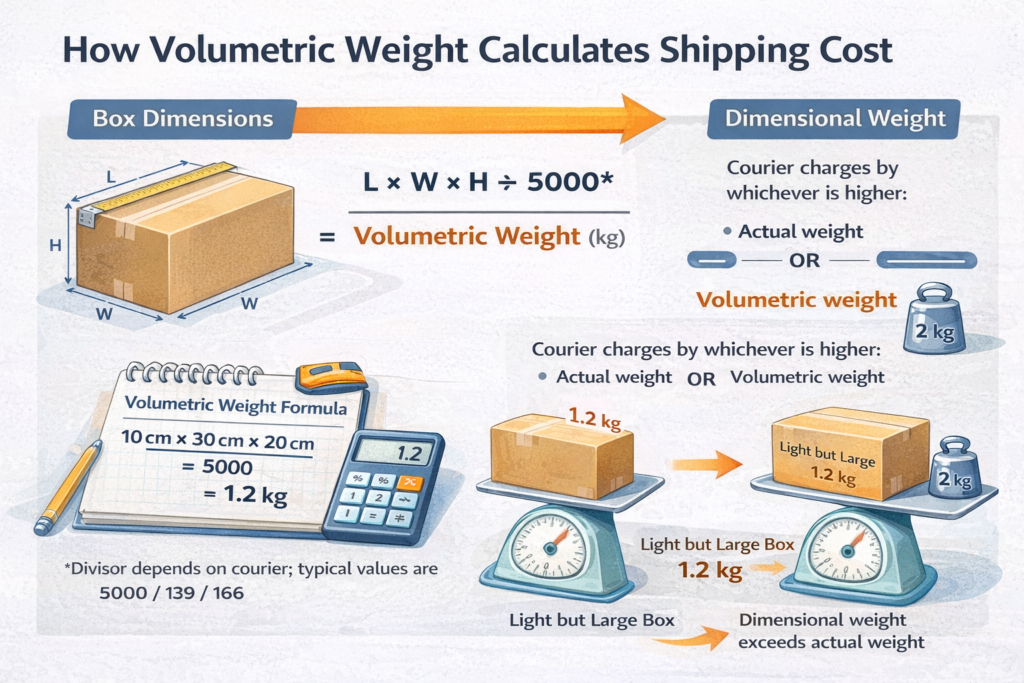
FedEx dimensional weight (DIM) explained
When can a small parcel consolidation tool backfire?
A small parcel consolidation tool is not always the cheapest option. It can backfire when:
- The final carton becomes too large (volumetric weight spike)
- Fragile items need separate protection (one carton becomes unsafe)
- You consolidate too early (waiting for missing parcels delays shipping)
- You lose clarity on which seller caused an issue (harder accountability)
- Restricted items force rerouting (increases delay and cost) Taobao Returns for Foreign Buyers
Should you always consolidate everything into one carton?
Not always. An innovative approach is "consolidate by risk group," such as:
- Fragile items: separate carton with extra protection
- Heavy items: separate carton to avoid large-size/overweight penalties
- Low-risk small items: consolidate tightly together
A small parcel consolidation tool is best used as a decision framework, not a default button.
How do you use a small parcel consolidation tool without losing order accuracy?
Consolidation works best when you control inputs. Most "wrong item" and "missing item" outcomes are upstream mistakes.
What information should you submit to prevent wrong variants?
For each Taobao item, maintain a simple "variant bundle" record:
- Color (exact listing label)
- Size (and sizing standard if relevant)
- Version/model (standard vs upgraded)
- Quantity
- Bundle (item-only vs item + accessories)
If the warehouse offers QC, your variant bundle becomes the reference for confirmation photos.
What proof should you keep for safer consolidation?
A clean evidence chain makes consolidation safer and easier to fix when something goes wrong. Save:
- Product link + variant screenshot
- Inbound receiving record (or inbound scan screenshot if provided)
- QC photos (when requested)
- Consolidation list (what was included)
- Final carton photo
- Final tracking number + dispatch date
This is not bureaucracy. This is what turns a small parcel consolidation tool into a repeatable business process.PayPal Buyer Protection for Taobao Orders
What are the most common mistakes buyers make during Taobao consolidation?
Most problems are not random. They are workflow gaps.
Mistake 1: Consolidating before all parcels arrive
If you ship too early, you either:
- Leave items behind, or
- Delay shipping because you must reopen the consolidation cycle
A better approach is to set a consolidation window, for example:
- "Wait until all parcels are inbound, then consolidate once."
Mistake 2: Ignoring repacking rules
If you do not specify packing preferences, repacking might default to "safe but large." That often increases box size and cost.
Applicable repacking instructions include:
- Remove unnecessary retail boxes (if not needed)
- Use smaller cartons when possible
- Add protection only where needed (fragile items)
- Provide the final carton photo for confirmation
Mistake 3: Skipping QC on high-risk items
QC is optional for low-risk items, but skipping it on high-risk items is expensive. High-risk means:
- Complex variants
- Size-sensitive items
- Fragile items
- Bundles with accessories
Mistake 4: Treating shipping cost as "weight only."
If you do not consider box dimensions, consolidation can result in a carton that is larger than necessary. A small parcel consolidation tool helps most when you actively manage carton size.
What is a practical SOP for repeatable Taobao consolidation?
If you want predictable results, run consolidation like a simple SOP.
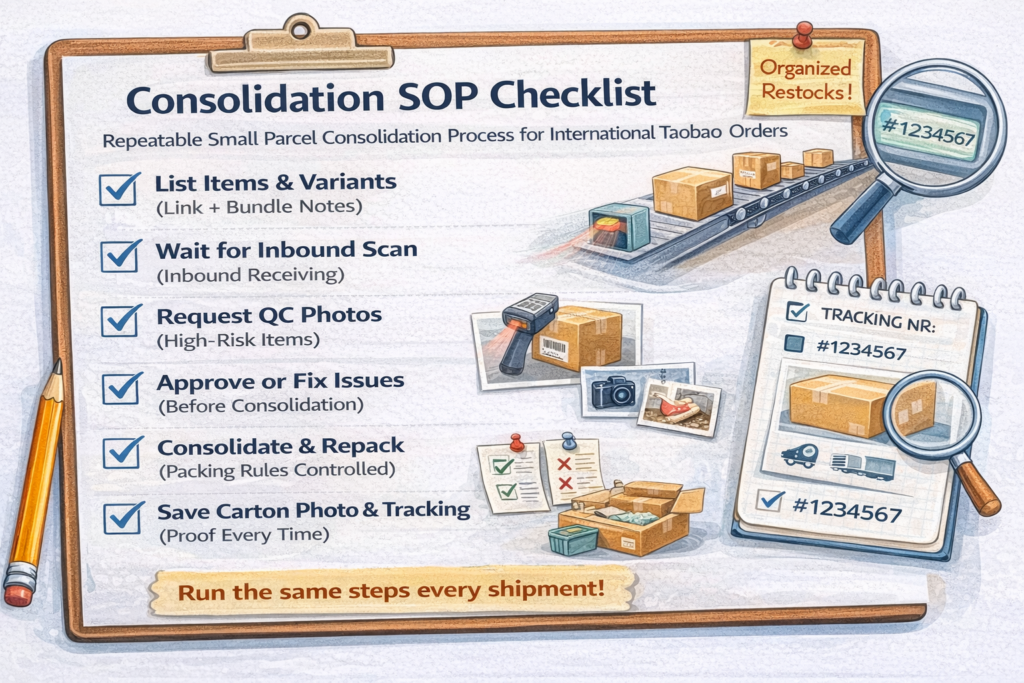
Step-by-step SOP using a small parcel consolidation tool
- List items and variants (variant bundle per item)
- Wait for inbound receiving confirmation for each parcel
- Request QC photos for high-risk items
- Approve or fix issues before consolidation
- Consolidate parcels with repacking instructions
- Confirm final carton photo + final tracking number
- Save the evidence chain for that shipment cycle
This SOP is what transforms a small parcel consolidation tool into a scalable tool, rather than a "maybe it works" feature.
FAQ: Small Parcel Consolidation Tool for Taobao Orders
What is the most significant benefit of a small parcel consolidation tool?
The most significant benefit is control: fewer shipments, more precise documentation, and fewer avoidable mistakes when buying from multiple Taobao sellers.
Do I always save money by consolidating parcels?
Not always. You save money when repacking reduces duplication and controls the size of boxes. If consolidation creates an oversized carton, volumetric weight can reduce or eliminate savings.
Should I use QC photos before consolidation?
If variants are complex or items are fragile, yes. QC photos often prevent expensive mistakes that are difficult to fix after international shipping.
When should I ship items separately instead of consolidating them?
Ship separately when items are fragile, heavy, or likely to trigger size-based cost spikes if combined into one carton. "Consolidate by risk group" is often the most practical approach.
What proof should I keep if something goes wrong?
Keep variant screenshots, inbound scans, QC photos, consolidation records, final carton photos, and final tracking information. These documents facilitate faster and more defensible problem resolution.
Final takeaway
A small parcel consolidation tool is not a cosmetic feature; it is a valuable asset. It is a workflow system that can reduce shipping complexity and improve repeat buying reliability-if you treat consolidation as a controlled process with clear inputs, QC where needed, and repacking rules that protect box size.
For consistent results, run the same consolidation SOP every time. That is how multi-seller Taobao buying becomes scalable rather than stressful.