China Buying Agent Service for Shopify Sellers: How to Source, QC, and Ship Without Costly Mistakes

Table of Contents
A China buying agent service is often the missing piece when Shopify sellers try to source from China at scale. The challenge is not finding products. The challenge is executing repeatable purchasing: selecting the correct variants, maintaining consistent quality, ensuring predictable shipping, and providing clean documentation when something goes wrong.
This guide explains how a China buying agent service works in real operations-step by step-so you can reduce wrong-item errors, prevent avoidable losses, and build a workflow you can run every week.
What is a China buying agent service, and what does it actually do for Shopify sellers?
A China buying agent service is a workflow provider that purchases from Chinese marketplaces or suppliers on your behalf, receives goods into a warehouse, and supports the preparation needed for international delivery. It is not only "placing orders." It is operational control.
For Shopify sellers, a China buying agent service typically helps with:
- Purchasing from platforms that may be difficult for foreign buyers to pay for directly
- Communicating with sellers when listings are unclear
- Warehouse receiving, sorting, and matching parcels to your orders
- Quality control (QC) photos and basic checks
- Parcel consolidation (multiple sellers → one shipment)
- Repacking to reduce volumetric weight and damage risk
- Providing documentation (order proof, warehouse records, tracking)
If you are running ads and restocking weekly, reliability matters more than "cheapest unit price."
Why does a China buying agent service matter more for repeat buying than for one-off purchases?
One-off buying tolerates friction. Repeat buying does not.
When you restock frequently, small mistakes compound:
- Wrong variant → delayed fulfillment + refunds
- Missing parts → bad reviews + chargebacks
- Multiple seller parcels → tracking confusion + loss risk
- Poor packing → damage + replacement cost
A good china buying agent service reduces these risks by standardizing the process.
When should you use a China buying agent service instead of buying directly?
A China buying agent service is most valuable when direct buying creates avoidable operational costs.
Use an agent workflow when:
- You buy from multiple sellers in the same week
- The listing has complex variants (versions, bundles, sizes)
- You need QC photos before international shipping
- You want consolidation to reduce shipping costs and tracking risk
- Your payment method fails or is inconsistent on Chinese marketplaces
- You need proof and documentation for disputes or supplier issues
If you only buy a straightforward item per month, direct buying may be fine. If you run a Shopify store, your risk profile is different.
What are the most common sourcing scenarios Shopify sellers run into?
Most Shopify sellers fall into one of these:
- Test orders (small quantity, validate product and photos)
- Restock cycles (weekly or bi-weekly repeat buying)
- Multi-seller carts (several suppliers to build one product line)
- Customization light (simple packaging inserts, label removal, bundle packing)
A China buying agent service becomes increasingly valuable as you progress from 1 to 4.
How does a China buying agent service workflow work from purchase to delivery?
A reliable workflow follows a predictable chain. Do not treat it as "send link, hope for the best."
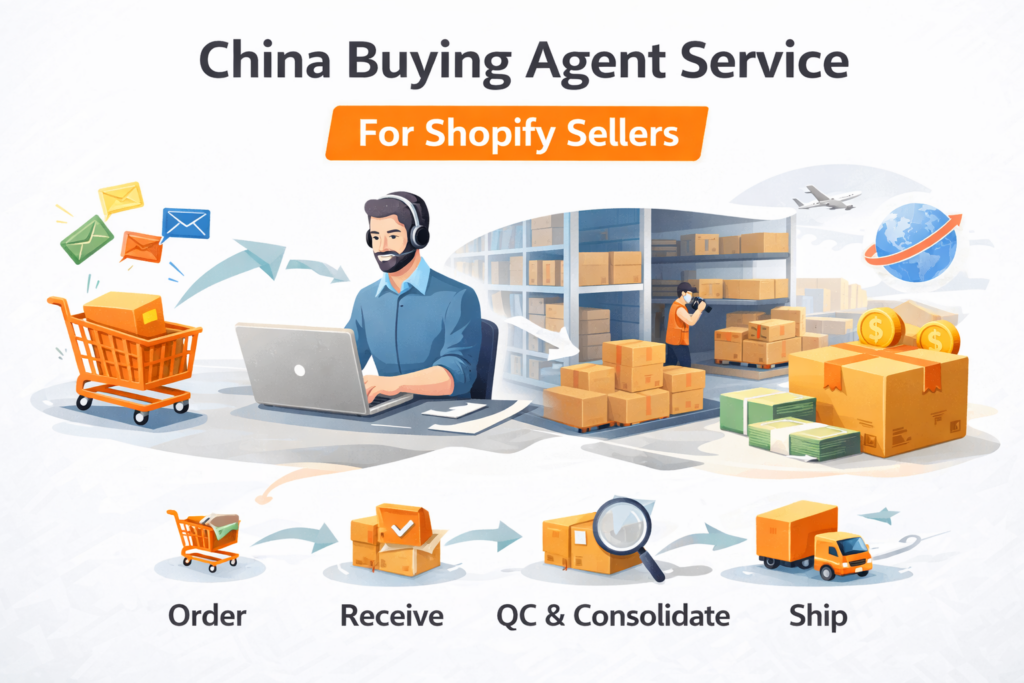
A typical China buying agent service process looks like this:
- You submit product links and variant requirements
- The agent confirms the price and purchasing details
- You fund the order (payment method depends on the platform)
- The agent purchases from the seller using domestic payment rails
- Parcels arrive at the warehouse and are scanned inbound
- QC photos are taken if requested
- Parcels are consolidated and repacked if needed
- International shipping is created, and tracking is issued
Your control points are steps 1, 2, 6, and 7. That is where most preventable mistakes happen.
What should you submit to avoid wrong purchases?
A link alone is not enough. For every item, submit a "variant bundle":
- Color (use the listing label, not your interpretation)
- Size (and which sizing standard)
- Version/model (standard vs upgraded vs "new" version)
- Quantity
- Bundle type (item-only vs item + accessories)
- Non-negotiables (must include box, must consist of cable, etc.)
This is the single most significant way a China buying agent service prevents wrong-variant failures.
How do you lock variants correctly when the listings are confusing?
Listings often contain options that resemble colors but are actually different versions of the same item. Or photos that do not match the dropdown.
To reduce mistakes, use a two-proof rule:
- Buyer proof: screenshot the selected variant on the listing
- Agent proof: request the agent's "what we bought" confirmation
If either proof is missing, you are operating on assumptions.
What is the simplest "no-argument" variant format to use?
Use structured notes, even if it feels strict:
- Color: "Black A" (exact label)
- Size: EU 42
- Version: Upgraded
- Bundle: Item + spare parts
- Notes: Must match photo set #3 on listing
This format makes a China buying agent service faster, not slower. It reduces back-and-forth later.
How do QC photos work in a China buying agent service, and what should you request?
QC photos are not "perfect authentication." They are operational confirmation.
A China buying agent service uses QC photos to confirm:
- The correct variant arrived (color/size/version)
- Key visible defects are caught early
- The product appears consistent with the listing
- Parts and accessories are present (when requested)
QC matters most when international shipping is expensive or slow, as fixing errors after export is costly.
What should your QC checklist include for the highest ROI?
For most Shopify sellers, ask for:
- Variant confirmation photo (color/size/version label if available)
- Front/back close-ups for visible defects
- Accessories laid out in one shot (if applicable)
- Measurement photo for size-sensitive items (when relevant)
- Final carton photo before dispatch (for packing proof)
A China buying agent service becomes dramatically more valuable when QC is standardized like a checklist.
How does consolidation reduce shipping costs, and under what circumstances can it backfire?
Taobao PayPal fees explained (real total cost)
Consolidation involves combining multiple domestic parcels into a single international shipment. It can lower costs and reduce operational risk, but it is not always guaranteed to be cheaper."
Consolidation helps when:
- You buy from multiple sellers
- Domestic packages are small and numerous
- You want one tracking number for one restock cycle
- You can remove bulky retail packaging
Consolidation can backfire when:
- Volumetric weight increases due to poor repacking
- Fragile items need separate protection
- You consolidate too early before all parcels arrive (creating delays)
A China buying agent service should be able to advise when to consolidate versus ship separately.
Why does volumetric weight matter more than most beginners expect?
International couriers often bill by whichever is higher:
- Actual weight
- Volumetric weight (box size-based)
If the final carton is too large, the shipping cost jumps even if the items are light.
That is why repacking rules matter:
- Remove unnecessary shoe boxes when you do not need them
- Use tighter cartons and protective fill
- Separate fragile items into smaller cartons if needed
The best China buying agent service treats packing as a cost control measure, not an afterthought.
How do payments usually work, and why do foreign buyers hit checkout problems?
Different platforms support foreign buyers differently. Even when cards are "supported," failures happen due to risk controls, verification prompts, or seller settings.
A China buying agent service is often used because it allows the agent to pay domestically, while you fund the agent through methods that are more consistent for international buyers.
What matters operationally is not the theory of payment options, but rather the actual implementation of these options. What matters is repeatable execution with proof.Taobao package consolidation to cut shipping costs
What should you confirm before you pay to avoid "paid too early" mistakes?
Before funding an order, confirm:
- The agent understands the exact variant bundle
- The item is in stock (or what the lead time is)
- QC requirements are noted
- Your consolidation plan is clear
- You understand fee categories (service, domestic ship, optional QC, international ship)
This protects you from misunderstandings that may later lead to refund conflicts.
What evidence should you keep to protect your Shopify store operations?
You do not document because you want disputes. You document because you want fewer disputes.
For every restock cycle, save:
- Product link + variant screenshots
- Your structured variant notes
- Agent purchase confirmation ("what was bought")
- Warehouse inbound scan or receiving record (if provided)
- QC photos (if requested)
- Consolidation record and final carton photo
- Tracking number and delivery status
- Unboxing photo/video if something arrives wrong or damaged
A China buying agent service works best when your evidence chain is clean.
What are the most common mistakes Shopify sellers make with a China buying agent service?
Most problems are not "bad luck." They are workflow gaps.
Common mistakes:
- Submitting links without variant bundles
- Using vague words like "same as picture."
- Paying before receiving confirmation
- Skipping QC on high-risk items
- Consolidating without repacking instructions
- Ignoring volumetric weight until the invoice arrives
- Not keeping proof of what was ordered vs. what was delivered
If you address these issues, your China buying agent service results become more predictable.
How do you create a repeatable SOP for weekly restocks?
Use this simple SOP and run it every time:
- Save link + variant screenshot
- Write structured variant bundle notes
- Request confirmation before payment
- Add QC checklist for high-risk items
- Wait for inbound receiving confirmation
- Review QC photos quickly and decide "ship or fix."
- Consolidate with repacking instructions
- Save final carton photo + tracking
When you operate like this, a China buying agent service becomes a scalable system, not a "helper."
What should you do when something goes wrong?
Start with the agent. Keep the message short and evidence-based.
Include:
- What you ordered (variant proof)
- What was confirmed (agent proof)
- What arrived (photos)
- What you want (reship, correction, partial refund, or return)
Clear evidence leads to faster resolution.
If the payment method you used offers dispute tools, the documentation above becomes your leverage. But the goal is to solve issues before they escalate.
FAQ: China Buying Agent Service for Shopify Sellers
Is a China buying agent service legal and normal for cross-border e-commerce?
Yes, using a purchasing agent and forwarding workflow is a standard operational model for cross-border buying. The practical focus should be on transparent fees, clear service scope, and compliant shipping.
How much does a China buying agent service usually cost?
Costs vary by provider and route, but the categories are consistent:
- Service or handling fee (if charged)
- Domestic shipping to the warehouse
- Optional QC and repacking
- International shipping
- Currency conversion costs from your payment method
You should evaluate the total cost, not only the product price.
Do I need QC photos for every order?
No. Use QC strategically. High-risk items and complex variants benefit most. Simple, low-cost items may not justify the added step.
What is the biggest reason Shopify sellers receive the wrong item?
Variant ambiguity. Missing version labels, unclear sizing standards, and not confirming "what was bought" cause most wrong-item outcomes.
How do I choose a reliable China buying agent service?
Look for process clarity, not marketing claims:
- Transparent fee structure and categories
- Proof-based purchasing (order confirmation)
- Warehouse receiving discipline (scan and match)
- QC capability with repeatable checklists
- Consolidation and repacking options
- Responsive communication with written records
A good china buying agent service feels like a well-oiled operation, not a guessing game.
Final takeaway: Treat your china buying agent service like a system, not a shortcut
A China buying agent service is most valuable when used to standardize purchasing. The winning formula is simple:
- Variant bundle + confirmation
- QC for high-risk items
- Consolidation with repacking rules
- Clean evidence chain
If you run your Shopify restocks through that system, you will reduce mistakes, control shipping costs more predictably, and scale with far less stress.