Shopify Sourcing From China: A Repeatable Workflow to Avoid Costly Mistakes (2026)

Table of Contents
Shopify sourcing from China remains one of the fastest ways to expand product selection and improve margins-but only if you can restock repeatedly without payment failures, incorrect variants, and unpredictable shipping costs. Most sellers do not lose money because "China is risky." They lose money because their workflow has no controls.
This guide provides a practical decision framework, including which sourcing path to use, how to lock variants, when to request QC photos, how consolidation affects costs, and what documentation can prevent disputes. The goal is not a one-time purchase. The goal is a repeatable process.
Why is Shopify sourcing from China still difficult for foreign sellers in 2026?
If you feel that "everything should work, but it doesn't," you are not imagining it. Cross-border sourcing breaks down in predictable areas, especially when scaling beyond a single seller.
Common pain points include:
- Payment friction (risk checks, verification loops, regional limits)
- Variant complexity (color/size/model confusion, bundles that look similar)
- Multi-seller logistics (several domestic parcels, missing items, scattered tracking)
- Cost surprises (volumetric weight, bulky packaging, extra handling steps)
The hard truth is that Shopify is optimized for selling, not for purchasing across multiple Chinese marketplaces. Your sourcing workflow must fill that gap.
What fails first: payment, variants, or logistics?
For most stores, variants fail first.
A payment failure is apparent, forcing you to stop. A variant mistake is quieter and expensive: you only discover it after the parcel is already in transit or after it reaches your customer. That is why the highest-leverage improvements are variant controls and QC proof-not just "finding a cheaper supplier."
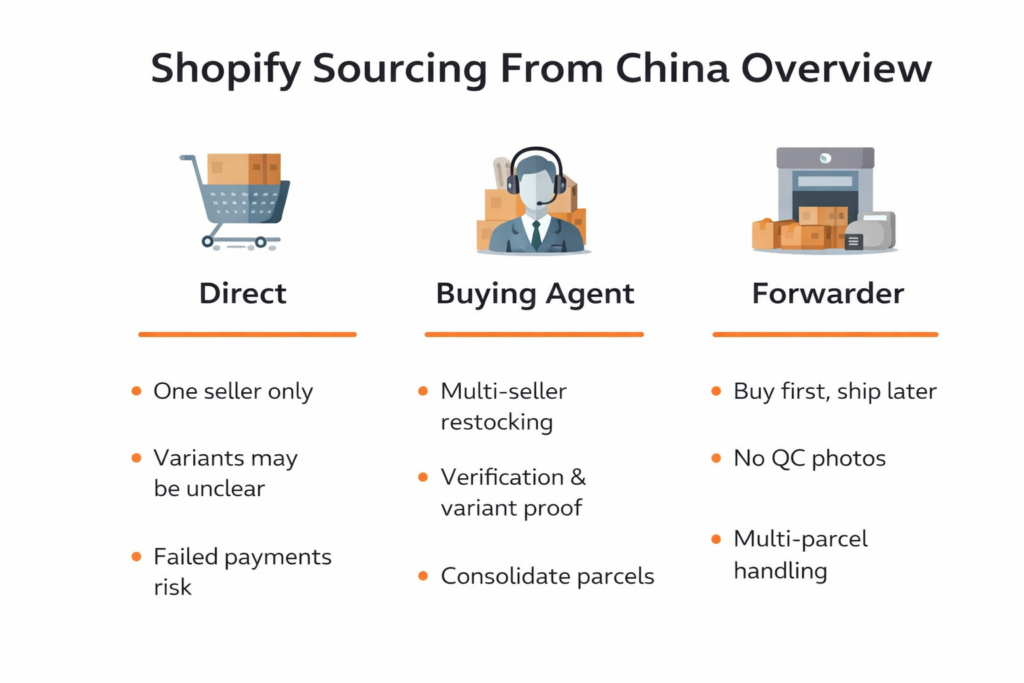
Which Shopify sourcing from China path should you choose?
There are three realistic paths. Each can work, but they suit different stages of the store and risk tolerance.
Should you buy directly if you only need one seller?
Direct buying can work when all of the following are true:
- You purchase from a single seller
- The listing has simple variants
- You can tolerate occasional checkout failures and retries
- You have a clear international shipping plan
Pros:
- Fewer middle steps
- Faster when it succeeds
Cons:
- Hard to scale to multi-seller restocks
- Less operational support for variant verification and consolidation
If your store restocks weekly across multiple SKUs, direct buying often becomes a time-consuming task.
Is parcel forwarding a good middle option?
Forwarding is best when you already know how to buy successfully, but you need a receiving address and international dispatch coordination.
Forwarding makes sense if:
- You can pay reliably on your own
- You do not need seller communication support
- You do not need QC photos beyond basic receiving checks
Pros:
- Useful for experienced buyers
- Simple receiving-to-shipping pipeline
Cons:
- Forwarding typically does not prevent wrong variants
- You still manage "what to buy" and "how to confirm it."
If variant mistakes are your #1 cost driver, forwarding alone is not enough.
When is a buying agent workflow the most stable choice?
A structured agent workflow is typically the most scalable option for repeat buying, particularly when sourcing from marketplaces with complex variant structures.
This route is strongest when:
- You buy from multiple sellers in one restock cycle
- You want QC photos before international shipping
- You want parcel consolidation to reduce tracking complexity
- You want a standardized "submit → confirm → receive → QC → consolidate → ship" process
If you need a general overview of how buying agents work, this internal reference is useful:
How do you build a repeatable SOP for Shopify sourcing from China?
Shopify sourcing from China becomes easy only when you stop treating it like shopping and start treating it like operations. A good SOP prevents the same problems every week.
Here is a practical, repeatable workflow:
- Save the product link and capture variant proof
- Write a structured "variant bundle" note (color/size/model/version)
- Submit the order and request confirmation of what will be purchased
- Pay only after the variant bundle is clearly locked
- Confirm inbound receiving when the parcel arrives at the warehouse
- Request QC photos for high-risk items
- Consolidate parcels into one international shipment
- Approve the final carton photo and dispatch
f your sourcing involves Taobao links, a DIY order approach can standardize your submissions:
What does "repeatable" mean in practice?
Repeatable means you can hand the workflow to a teammate and get the same result. If your process relies on memory, chat screenshots, or "I'll notice it later," it will break as volume increases.
How do you lock variants to prevent wrong-item losses in Shopify sourcing from China?
Most wrong-item outcomes are not caused by "bad sellers." Ambiguous instructions cause them.
Use a "variant bundle" every time you submit a link:
- Color: use the listing's exact label (not just "black")
- Size: include the sizing standard if relevant (EU/US/CN)
- Model/version: standard vs upgraded vs new release
- Bundle: item only vs item + accessories
- Quantity: Include pack size (e.g., one piece, 2-piece set, etc.)
- Notes: must-have details that cannot be guessed
Then use the two-proof method:
- Your proof: screenshot showing the selected variant on the listing
- Purchase proof: confirmation of what was actually ordered
If you can only make one improvement, make this one. It reduces the most expensive category of mistakes.
What if the listing has too many options?
Do not write long paragraphs. Use a structured block:
- Color: "Black A" (exact label)
- Size: 42 EU
- Version: Upgraded
- Bundle: Item + spare parts
- Notes: Must include accessories shown in listing
Clear structure beats long explanations.
When should you request QC photos in Shopify sourcing from China?
QC photos are not "for every item." They are for items where one mistake costs more than the cost of the QC service.
Request QC photos for:
- Fashion items with similar-looking variants
- Shoes (size and model mix-ups are common)
- Electronics accessories (compatibility risks)
- Fragile items (damage risk during domestic transit)
- Anything you plan to resell at a premium
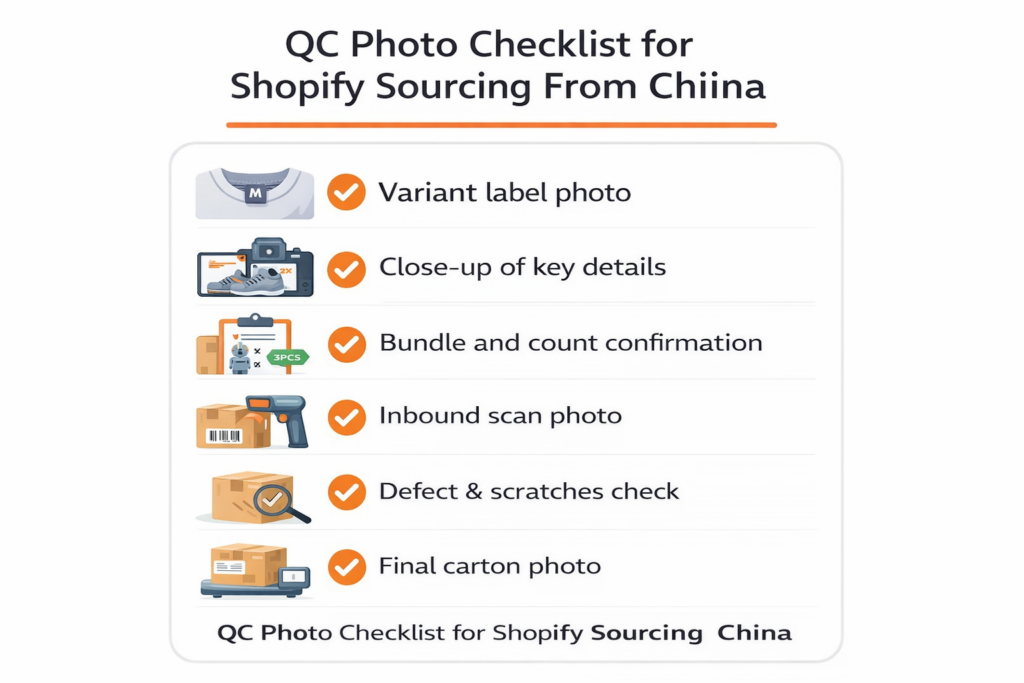
QC photos should prove specific facts, not general satisfaction.
High-impact QC checklist:
- The variant label is visible and matches the variant bundle
- Quantity count is visible
- Key details shown close-up (size tag, model number, ports, materials)
- Obvious defects checked (scratches, stains, missing parts)
- Final carton photo before dispatch
QC is most valuable because it catches mistakes before international shipping, when fixes are cheaper and faster.
How does consolidation change cost and delivery risk in Shopify sourcing from China?
If you buy from multiple sellers, you are not managing one shipment. You are managing a chain of domestic parcels that must be consolidated into a single export shipment.
Consolidation helps because it:
- Reduces tracking fragmentation
- Allows repacking to cut packaging waste
- Reduces volumetric-weight risk (when box size inflates shipping cost)
- Prevents partial dispatch issues across multiple parcels
If you want a consolidation-focused reference:
And if you want time expectations for consolidated parcels:
When does consolidation not save money?
Consolidation does not always reduce cost if:
- One parcel is already small and efficient
- Your items are fragile and require extra protection
- Repacking increases labor or adds protective materials
Even then, consolidation often saves time and reduces operational complexity, which is particularly important for Shopify sellers.
What costs should you budget for when sourcing from China on Shopify?
Never budget only for the item price. Budget for total landed cost, or your margins will be wrong.
Typical cost categories include:
- Item price
- Domestic shipping (seller → warehouse)
- Service fee (if applicable)
- FX conversion spread (platform/bank/payment provider)
- International shipping (actual weight or volumetric weight)
- Optional services (QC photos, repacking, consolidation)
A practical rule: if your landed cost estimate does not include the effects of domestic shipping and packaging, it is incomplete.
What should you do when something goes wrong?
When something fails, your speed and documentation matter more than arguments.
Use a short escalation sequence:
- Contact the platform/agent with a factual summary
- Attach the variant bundle proof and purchase proof
- Attach receiving/QC photos if relevant
- Request a specific resolution: replace, refund, or correction
If you paid through PayPal in a platform transaction, PayPal reviews the PayPal transaction and supporting evidence. Do not assume PayPal is evaluating the original marketplace listing. Use official terms as your reference point:
This is why documentation is not "extra." It is operational insurance.
FAQ
Is Shopify sourcing from China more beneficial for new stores or established ones?
Both can benefit, but established stores benefit more because consistent restocking reduces stockouts, delivery delays, and customer support load. New stores should start with fewer SKUs and stronger QC to prevent early reputation damage.
What is the most common reason this workflow fails?
Variant ambiguity. Missing version labels, unclear bundle choices, and size standard confusion cause the most costly mistakes, not shipping itself.
Do I need QC photos for every order?
No. Use QC for complex variants and high-risk items. Skip QC for low-cost, low-variance items to maintain workflow efficiency.
Does consolidation always reduce shipping costs?
Not always. It often reduces complexity, but savings depend on box size, volumetric weight, and whether repacking reduces wasted space.
What is the simplest way to reduce wrong-item disputes?
Use two-proof confirmation: your variant screenshot plus an order confirmation record of what was purchased. Without both, it becomes hard to prove a mismatch.
What documentation should I keep for each restock cycle?
Keep:
- Product link + variant screenshot
- Variant bundle note
- Purchase confirmation
- QC photos (if requested)
- Consolidation record
- Tracking number and delivery status
- Unboxing photos/video if something is wrong
Quick decision checklist
Choose a buying agent workflow if:
- You restock frequently
- You buy from multiple sellers
- You want QC and consolidation
Choose direct buying if:
- You have a simple, single-seller order
- You can tolerate failed payment retries
Choose forwarding if:
- You can already buy reliably
- You only need receiving and dispatch support