Consolidation vs Direct Shipping From China: When Consolidation Wins (And When It Doesn't)

Table of Contents
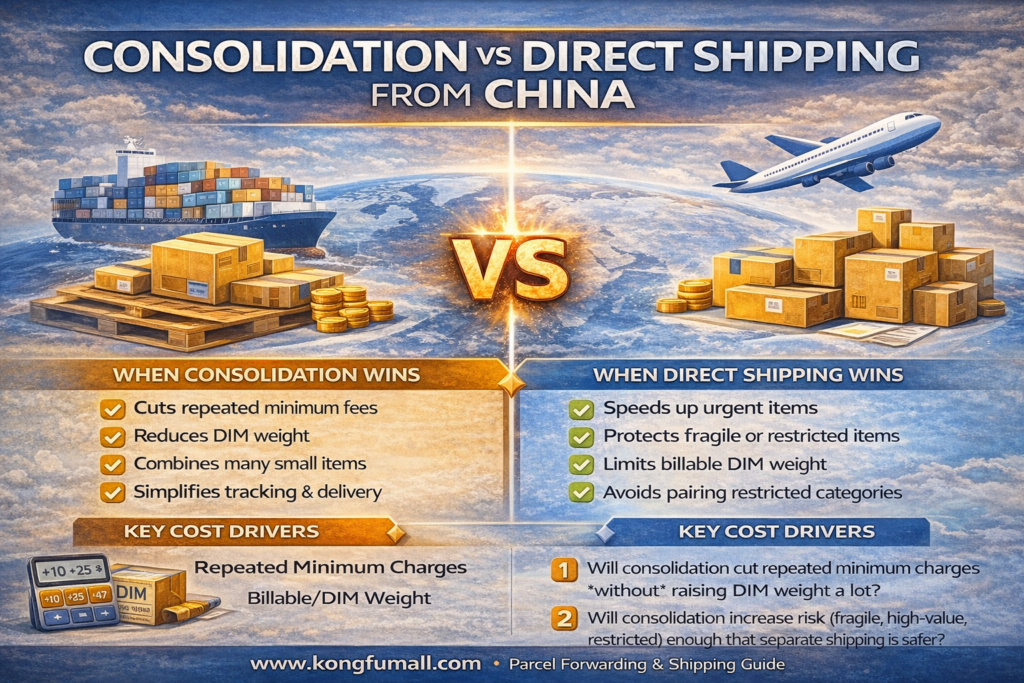
Choosing consolidation vs direct shipping is not a preference question. It is a cost-and-risk decision. Consolidation can cut waste and simplify delivery, but it can also backfire when it creates a bulky carton, triggers higher billable weight tiers, or forces you into slower shipping rules. Direct shipping can be faster and safer for specific items, but it often doubles up on fees and creates tracking chaos when you buy from multiple sellers.
This guide explains consolidation vs direct shipping in real-world terms: what changes your total cost, what changes your risk, and how to decide using clear scenarios and simple checks.
What Is the Real Decision Behind Consolidation vs Direct Shipping?
The practical difference in consolidation vs direct shipping is where you "pay for complexity."
- Consolidation moves complexity out of the warehouse workflow, so you ship fewer parcels.
- Direct shipping pushes complexity to your doorstep by letting each seller ship separately.
The better option depends on whether your primary constraint is:
- cost predictability
- speed
- damage risk
- customs simplicity
- tracking and delivery convenience
When Does Consolidation vs Direct Shipping Matter Most?
If you are buying from a single seller, consolidation vs. direct shipping may not matter much. But it becomes a significant decision when:
- You buy from multiple sellers (Taobao/1688/marketplaces)
- Each seller uses a different packaging quality
- You have mixed items (soft goods + fragile items)
- You want one delivery instead of many
Who is this comparison for?
This article is most useful if you want to answer:
- "Will consolidation actually reduce my total cost?"
- "Will direct shipping reduce my risk or speed up delivery?"
- "How do I avoid a decision that looks cheap but becomes expensive later?"
What Are the Core Cost Drivers in Consolidation vs Direct Shipping?
Most buyers compare shipping rates only. That is not enough. Three things drive the cost difference in consolidation vs direct shipping:
- Repeated minimum charges
- billable weight (actual vs dimensional)
- added warehouse services (repacking, handling, storage)
Why repeated minimum charges favor consolidation
When you direct ship multiple parcels, you often pay:
- multiple base charges
- multiple fuel or service minimums
- multiple last-mile handoffs
Consolidation usually reduces those repeated costs by turning many parcels into one or two.
Why billable weight can flip the result
Billable weight is commonly the higher of:
- actual weight
- dimensional weight (DIM)
This is why consolidation sometimes loses. A single combined carton can become bulky, pushing the DIM weight above the sum of the smaller cartons.
Why "small" fees matter at scale
In consolidation vs direct shipping, warehouse fees are rarely huge. But they become meaningful when:
- You consolidate tiny items
- You require heavy protection
- You wait long enough to pay storage fees
When Does Consolidation Win in Consolidation vs Direct Shipping?
Consolidation wins when it removes waste, reduces repeated charges, and keeps billable weight under control.
Does consolidation win when you have many small parcels?
Yes, often.
Consolidation wins when:
- You have 3+ parcels
- Each parcel is light
- Seller's packaging is bulky
- You want one tracking number
This scenario typically benefits from repacking and volume reduction.
Does consolidation win when sellers use oversized boxes?
Yes, if repacking reduces dimensions.
Many sellers ship air. Consolidation can remove:
- thick outer cartons
- space
- redundant bubble wrap
- Extra fillers added by sellers "just in case."
If DIM weight dominates, this is where consolidation wins hardest.
Does consolidation win for soft goods?
Usually, yes.
Soft goods tend to be:
- durable
- compressible
- easy to repack efficiently
That makes consolidation vs direct shipping tilt toward consolidation.
Does consolidation win for delivery convenience?
Yes, and this is underestimated.
Consolidation reduces:
- missed deliveries
- multiple courier appointments
- tracking confusion
- scattered arrival dates
If you value simplicity, consolidation often wins even when the cost difference is negligible.
When Does Direct Shipping Win in Consolidation vs Direct Shipping?
Direct shipping wins when speed, packaging integrity, or risk control matter more than optimization.
Does direct shipping win when you need speed?
Often, yes.
If one item is urgent, direct shipping can be faster because:
- It avoids waiting for other parcels
- It avoids warehouse processing time
- It reduces batching delays
If time matters, consolidation vs direct shipping often favors direct shipping for the urgent item.
Does direct shipping win for fragile or high-value items?
Sometimes, yes.
Consolidation can increase risk when:
- Fragile items are mixed with heavier items
- Repacking removes the protective original packaging
- The final carton is handled more times
For fragile or high-value goods, direct shipping (or separate shipping) is often safer.
Does direct shipping win when one carton creates a tier jump?
Yes, this is one of the most common "consolidation fails."
If consolidation pushes you into:
- a higher weight tier
- an oversize category
- a method that bills DIM heavily
Then direct shipping (or splitting into two cartons) can be cheaper.
Does direct shipping win for restricted categories?
It can.
Some items require special routing or restrictions (e.g., batteries, liquids, etc.). Consolidating restricted items with everyday items can require the entire carton to be handled as special, or it can cause delays. In these cases, direct shipping or separating categories can be smarter.
How Do You Decide Consolidation vs Direct Shipping Without Guessing?
You do not need perfect pricing. You need a decision framework that reduces obvious mistakes.
Step 1: Start with parcel count and arrival timing
Use these quick rules:
- 1–2 parcels: direct shipping is often fine
- 3+ parcels: consolidation is usually worth evaluating
- Late sellers: Ship in batches to avoid storage delays
This is the first filter in consolidation vs direct shipping.
Step 2: Identify whether DIM weight is your main risk
DIM weight dominates when:
- Items are light
- The boxes are large
- You are paying for "air."
If DIM weight dominates, consolidation usually has upside, especially with repacking.
Step 3: Use a "one box vs two box" check
Ask one question:
- Will one consolidated carton be bulky enough to jump tiers?
If yes, compare:
- one carton
- two cartons
- direct shipping
In consolidation vs direct shipping, "two cartons" is often the best compromise.
Step 4: Sort items by risk, not by seller
Do not group parcels only by seller. Group by risk:
- soft goods together
- fragile items separated
- restricted categories separated
- Heavy items away from delicate items
This single habit prevents many consolidation losses.
Step 5: Decide repacking level using a simple rule
Repacking should match item type:
- soft goods: remove outer boxes, light padding
- mixed goods: moderate padding and separation
- fragile: reinforced packing, possibly double-boxing
- high-value fragile: separate shipping if risk is unacceptable
This keeps consolidation vs direct shipping a controlled decision rather than a gamble.
Real Scenarios: Consolidation vs Direct Shipping Outcomes
Scenario 1: Four clothing parcels from different sellers
Best choice: consolidation
Why consolidation wins:
- parcels are light
- Seller boxes are often oversized
- Repacking reduces DIM weight
- One delivery is easier
In consolidation vs direct shipping, this is the classic consolidation win.
Scenario 2: Two parcels, one urgent item
Best choice: split strategy
- Ship the urgent item directly
- consolidate the rest later
This avoids paying for speed on non-urgent items.
Scenario 3: One fragile item mixed with heavy items
Best choice: direct shipping or separate carton
Why direct shipping wins:
- Mixing increases damage risk
- Repacking can remove structural protection
- One damaged item can erase any savings
In consolidation vs direct shipping, risk can outweigh cost.
Scenario 4: Many tiny parcels with minimal packaging
Best choice: depends
If seller packaging is already minimal, consolidation might:
- Save a little volume
- Add service fees
- Add processing time
Here, direct shipping can be competitive if you tolerate multiple deliveries.
Scenario 5: Consolidation creates a giant carton
Best choice: usually not one carton
If one carton becomes bulky:
- DIM weight spikes
- You may hit oversize thresholds
- The result can cost more than two cartons
In consolidation vs direct shipping, this is when consolidation "doesn't win" unless you split intelligently.
Common Mistakes That Make the Wrong Choice in Consolidation vs Direct Shipping
Mistake 1: Assuming one box is always cheaper
One box is not always cheaper. It can be more expensive due to tier jumps. Always do a quick split comparison.
Mistake 2: Ignoring dimensional weight
DIM weight is the most common reason for consolidation losses. If you do not consider dimensions, you are guessing.
Mistake 3: Mixing fragile with heavy items
This increases damage risk and often increases packaging requirements, which can raise costs and DIM weight.
Mistake 4: Waiting too long for one late seller
This creates delays and can add storage fees. Batch shipments are often smarter.
Mistake 5: Consolidating restricted items with everyday goods
This can force special routing for the whole carton-separate categories to keep routing clean.
FAQ: Consolidation vs Direct Shipping From China
Is consolidation vs direct shipping mainly about saving money?
Money is a significant factor, but convenience, ease of tracking, and risk control are equally essential. The best choice is the one that fits your constraint.
Can consolidation be cheaper but still a bad decision?
Yes. If the shipment is fragile or high-value, the downside of damage can outweigh savings.
When should I split into two cartons?
Split when one carton:
- becomes bulky
- risks a tier jump
- mixes heavy and delicate items
- includes restricted categories
Two cartons often beat both extremes in terms of consolidation vs. direct shipping.
How do I decide if my situation is DIM-heavy?
If the items are light but the boxes are large, assume DIM risk is high. Consolidation with repacking usually helps in that case.
Final Takeaway: Use Consolidation vs Direct Shipping as a Two-Question Test
If you want a simple way to decide between consolidation and direct shipping, ask:
- Will consolidation reduce repeated minimum charges without triggering a significant increase in DIM weight?
- Will consolidation increase risk (fragile/high-value/restricted) enough that separate shipping is safer?
If the answer to the first is "yes" and the second is "no," consolidation usually wins. If the first is "no" or the second is "yes," direct shipping or a split strategy is often the more intelligent decision.