Parcel Consolidation Cost: Real Fees Breakdown (Repacking, Handling, Shipping) + Examples

Table of Contents
Parcel consolidation cost is rarely "just shipping." It is a bundle of small decisions and small fees that add up: inbound receiving, storage timing, repacking choices, materials, handling, and the final outbound rate-often billed by billable weight (actual vs dimensional). If you do not understand the fee structure, you can still consolidate correctly and end up paying more than expected.
This guide breaks down parcel consolidation cost in plain terms, shows how to estimate your real total before you pay, and includes practical examples so you can choose consolidation only when it makes financial sense.
What Does "Parcel Consolidation Cost" Actually Include?
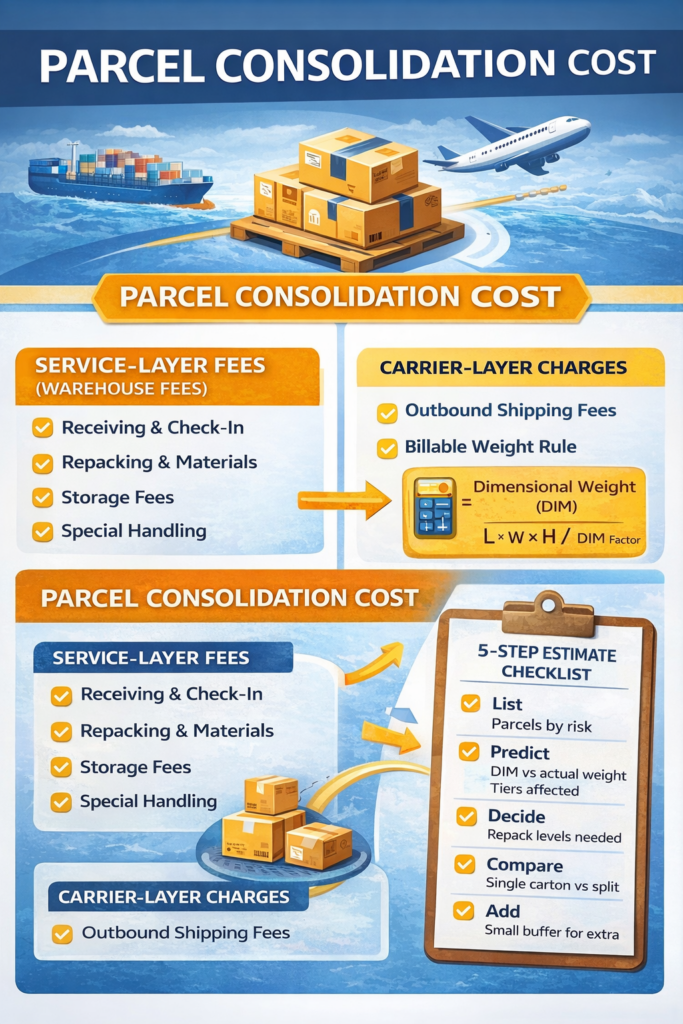
A realistic parcel consolidation cost has two layers:
- Service-layer fees (what happens in the warehouse)
- Carrier-layer charges (what happens after dispatch)
Understanding which layer drives your total is the fastest way to reduce surprises.
What are service-layer fees?
These are fees tied to operations inside the consolidation workflow, such as:
- receiving and check-in
- optional photos or verification
- packing work and materials
- storage after free days
- exceptional handling (fragile, oversized, restricted categories)
Some services bundle these into a single line item. Others split them out. Either way, you pay for labor and materials somewhere.
What are carrier-layer charges?
These charges are driven by the shipping method you choose and how carriers calculate billing. The most important concept is:
- billable weight = max(actual weight, dimensional weight)
If your final carton is bulky, dimensional weight can dominate your parcel consolidation cost even if the items are light.
Why Do Buyers Misjudge Parcel Consolidation Cost So Often?
Most buyers underestimate parcel consolidation cost for one reason: they focus on the item price and forget that packaging and billing rules can be more expensive than expected.
What causes the highest "hidden" cost jumps?
Common causes include:
- Too much seller packaging that inflates dimensions
- Consolidating into one large carton that crosses a pricing tier
- Adding excessive padding that increases the actual weight
- Waiting too long and triggering storage fees
- Mixing items that require special shipping methods
A correct estimate is not about guessing cheaper shipping. It is about controlling billable weight and avoiding avoidable service charges.
How Are Repacking Fees Calculated?
Repacking is the part of parcel consolidation cost you can influence the most. But "repack" is not a single action-it can mean many different actions with different cost impacts.
What does "repacking" usually mean?
Repacking can include:
- removing outer seller boxes
- combining inner packages into one carton
- adding void fill (air pillows, paper, bubble wrap)
- reinforcing corners or seams
- double-boxing fragile items
- separating items inside the carton (dividers)
Each step adds time and materials. More repacking often reduces dimensions, but not always.
When does repacking reduce cost?
Repacking reduces parcel consolidation cost when it:
- reduces carton dimensions enough to lower dimensional weight, or
- prevents damage that would create a "total loss" outcome
For light items, dimensional weight is often the real enemy. Removing wasted space can move you into a cheaper tier.
When does repacking increase cost?
Repacking can increase parcel consolidation cost when it:
- adds heavy materials unnecessarily
- creates a larger carton than two smaller cartons would be
- upgrades to double-boxing without a real fragility need
The goal is right-fit protection, not maximum protection.
What Handling Fees Should You Expect?
Handling fees are not always listed as "handling." They can appear as "service," "operation," "processing," or "warehouse work." But they usually fall into predictable buckets.
Which handling actions commonly affect parcel consolidation cost?
- Receiving & check-in: verifying parcels arrived and logging them
- Sorting: grouping parcels into your requested batch
- Basic packing labor: taping, sealing, labeling
- Optional QC or photos: extra time and documentation
- Special handling: fragile, oversized, or category-restricted items
If your service offers photos, that can be valuable for risk control. But it is still part of the parcel consolidation cost.
How Do Storage Rules Affect Parcel Consolidation Cost?
Storage is one of the most common "silent" add-ons, especially when one seller delays shipment and the rest of your parcels arrive early.
Why storage fees happen
Many warehouses offer a free storage window. After that, storage becomes paid. Storage fees exist for a genuine operational reason: warehouse space has a carrying cost.
How to avoid storage-driven cost creep
- Consolidate in batches instead of waiting for one late parcel
- Set a "cutoff date" for late arrivals
- Ship the batch and let the late parcel start a new batch
- Avoid ordering from slow sellers if timing matters
This is not only about saving money. It is also about preventing workflow delays.
How Shipping Charges Dominate Parcel Consolidation Cost
Shipping is often the most significant part of parcel consolidation costs, but it is also the most misunderstood. The key is billable weight.
What is billable weight?
Billable weight is the weight carriers charge for. It is usually the greater of:
- actual weight (scale weight)
- dimensional weight (based on carton size)
This is why a large but light carton can be expensive.
Why does dimensional weight matter more after consolidation
When you consolidate, you often create one "main carton." If that carton is not packed efficiently, you may trigger high-dimensional weight. That can erase savings from combining parcels.
What you should do before you pay
Before confirming dispatch, try to know:
- estimated carton dimensions (even approximate)
- estimated actual weight
- whether the shipping method uses dimensional weight rules
- whether splitting into two cartons reduces the billed tier
A good workflow estimates these factors instead of shipping unthinkingly.
What are the Most Common Fee Items in Parcel Consolidation costs?
Even if pricing varies by provider, the fee taxonomy is consistent. Use this list as your mental checklist.
Fee checklist (warehouse + shipping)
- Receiving / inbound check-in
- Basic processing/operation fee
- Repacking fee (labor)
- Packing materials fee (bubble wrap, cartons, tape)
- Optional photos / QC fee
- Special handling fee (fragile/oversized)
- Storage fee (after free days)
- Outbound shipping charge (carrier rate)
- Optional insurance fee (if offered)
Not every shipment will include all items. But most surprise totals come from ignoring 2–3 of these categories.
How Can You Estimate Parcel Consolidation Cost Before You Ship?
A proper estimate is not a perfect number. It is a decision-grade range: "Is consolidation likely cheaper, neutral, or more expensive?"
Step 1: List your parcels and group them by risk
Make a short table for yourself:
- parcel count
- item type (soft goods vs fragile)
- urgency
- restricted category risk
- expected packaging bulk (high/medium/low)
This determines whether you should consolidate into a single carton or split it into multiple cartons.
Step 2: Predict whether dimensional weight will dominate
Dimensional weight is more likely to dominate when:
- The items are light (clothes, accessories)
- Sellers used large boxes
- You are shipping "air" more than the product
In these cases, repacking can significantly reduce parcel consolidation costs.
Step 3: Decide repacking level using a simple rule
Use this practical rule:
- Soft goods: remove outer boxes, light padding
- Mixed goods: moderate padding, separate heavy from delicate
- Fragile items: reinforced packing, possibly double-boxing
- High-value + fragile: consider separate shipping for risk control
This is how you prevent paying for protection you don't need.
Step 4: Compare one box vs two boxes
Many buyers assume "one box is always cheaper." That is not always true.
Two cartons can be cheaper when:
- One carton would push you into a higher billable tier
- One carton would become too bulky and trigger high DIM weight
- You need to separate fragile or restricted items anyway
A quick "one vs two" comparison often saves more than any micro-fee optimization.
Step 5: Add a realistic buffer
Even with good planning, small variables remain: final tape layers, final carton choice, and final measured dimensions. Use a small buffer to avoid budget shock.
Examples: Parcel Consolidation Cost in Real Scenarios
The goal of examples is not to give universal pricing numbers. Providers and routes differ. The goal is to show which cost drivers matter.
Example 1: Light items with bulky seller boxes (soft goods)
Situation
- 4 parcels: clothing + small accessories
- low fragility, low restriction risk
- Seller boxes are oversized
Cost logic
- Without consolidation: 4 separate shipments = repeated minimum charges + repeated handling
- With consolidation, repacking removes wasted volume, and DIM weight drops
Result
Parcel consolidation costs are often lower because dimensional waste is reduced, and you pay shipping only once.
Example 2: Mixed items, including one fragile product
Situation
- 3 parcels: clothing + small electronics accessory + fragile item
- moderate risk because the fragile item needs protection
Cost logic
- Consolidate clothing and accessories together with light padding
- Ship fragile items separately or use reinforced packing inside a split carton setup
Result
Parcel consolidation costs may be lowest with a split strategy: not "all-in-one" or "all separate," but a controlled grouping.
Example 3: Heavy items that create tier jumps
Situation
- 2 parcels: heavy components or dense items
- actual weight is already high, packaging is not bulky
Cost logic
- Consolidation might push the total into a higher weight tier
- Repacking offers little dimensional benefit because DIM weight is not the issue
Result
Parcel consolidation cost may increase or stay flat; shipping separately can be rational if minimum charges are not punitive.
Example 4: One delayed seller causing storage creep
Situation
- 5 parcels expected, 4 arrive early, 1 delayed for 10–14 days
Cost logic
- Waiting triggers storage fees and delays dispatch
- Shipping the 4 as one batch avoids storage creep and keeps the timeline stable
Result
Parcel consolidation cost is controlled by batching. This is often the most brilliant move, even if you later ship the last parcel separately.
How Can You Lower Parcel Consolidation Cost Without Increasing Risk?
Cost reduction should never be "cheaper at any cost." The right approach is to reduce waste and avoid fee triggers.
Practical cost-control tactics
- Remove wasted outer boxes when items are durable
- Avoid over-padding soft goods
- Split heavy + fragile items to reduce damage risk
- Ship in batches to avoid storage fees
- Check billable weight before final payment
- Use two cartons if one carton creates a tier jump
- Avoid restricted items in the same carton when the rules are unclear
These tactics reduce parcel consolidation cost while keeping outcomes predictable.
FAQ: Parcel Consolidation Cost
Is parcel consolidation cost always cheaper than shipping separately?
No. Parcel consolidation costs are lower when consolidation reduces dimensional weight or avoids repeated minimum charges. It can be higher if consolidation pushes you into a new billed tier or requires heavy protection.
What single factor changes the parcel consolidation cost the most?
For many international routes, billable weight is the most significant driver. If dimensional weight dominates, repacking efficiency matters more than small service fees.
Should I continuously remove seller boxes?
Not always. Remove boxes that add space without protecting the item. Keep packaging that provides structure for fragile goods.
Is it better to consolidate into one box or two?
It depends. One box is often simpler, but two boxes can reduce tier jumps and lower risk for mixed shipments. The best choice is the one with lower billable weight and lower damage probability.
Final Takeaway: Treat Parcel Consolidation Cost as a Design Problem
Parcel consolidation costs become predictable when you treat them as a workflow design problem, not a last-minute shipping decision-separate service-layer fees from carrier-layer charges. Focus on billable weight. Use repacking to remove waste, not to add unnecessary materials. And when one carton becomes too large, split it.
Do that, and you will avoid the most common cost surprises-while still getting the main benefit of consolidation: one cleaner shipment that is easier to track, receive, and manage.