Why Small Brands Rely on Chinese Shopping Before Scaling

Table of Contents
Chinese Shopping is one of the fastest ways for small brands to move from "idea stage" to "real products in customers' hands" without burning months on slow supplier outreach. When you're still validating demand, you need speed, variety, and a sourcing workflow you can repeat. That's why so many early-stage brands lean on Chinese Shopping before they scale.
This guide explains what small brands actually use Chinese Shopping for, where the real risks lie, how to maintain quality stability, and how to build a simple sourcing system that won't collapse as your orders grow.

1. Why do small brands use Chinese Shopping before they scale?
1.1 Are they "cutting corners" or building speed?
Most small brands aren't trying to cut corners. They are trying to reduce uncertainty.
In the early stages, the most significant risk is not "a slightly imperfect product." The most crucial risk is spending months and money on something that customers don't want.
Chinese Shopping helps small brands:
- Test multiple product options quickly
- Compare materials and features side-by-side
- Run small-batch trials before committing to larger runs
- Build a "good enough" supply chain while validating demand
1.2 Why speed matters more than perfection at the start
Before scaling, brands need answers:
- Will customers buy this product at all?
- Which version performs better (size, color, feature, packaging)?
- What do buyers complain about?
- What do they love enough to repurchase?
Chinese Shopping supports quick iteration. That iteration becomes market-proof, and market-proof is what unlocks scaling.
2. What does Chinese Shopping actually include for brands?
2.1 Is it just "buying random stuff online"?
No. For small brands, Chinese Shopping is usually a structured approach to sourcing across China's domestic platforms and supply channels.
It often includes:
- Marketplace sourcing (broad product discovery)
- Factory and wholesale sourcing (repeatable restock)
- Packaging and accessory sourcing (brand-ready presentation)
- Shipping consolidation (multiple suppliers into one shipment)
- Inspection and verification (avoid nasty surprises)
2.2 Why platforms like 1688, Taobao, and Pinduoduo matter
Small brands usually source different things from different platforms:
- 1688: wholesale supply, factory-style listings, bulk-friendly options
- Taobao: wide variety, niche accessories, packaging, creative add-ons
- Pinduoduo: deal-heavy listings, high-volume items, fast experimentation
Chinese Shopping isn't one store. It's an ecosystem. Small brands use it to build a flexible supply stack.
3. What problems does Chinese Shopping solve for small brands?
3.1 "I need samples fast"-how Chinese Shopping helps
When you don't have a supplier network yet, sample sourcing can be slow.
Chinese Shopping makes it easier to:
- Pull 3–10 sample options quickly
- Compare the build quality and finish
- Decide which supplier is "stable" for repeat orders
- Create your product spec based on real items
I've seen brands move from concept to sample testing in a short cycle simply because sourcing no longer becomes a bottleneck.
3.2 "I need variety"-how brands use China to explore options
Small brands rarely know the perfect version of a product on day one.
They usually test:
- Different materials
- Different sizes and shapes
- Different accessories and bundles
- Different packaging formats
Chinese Shopping supports this exploration because the SKU depth is tremendous.
3.3 "I need repeatable restock"-how brands avoid chaos
Scaling isn't just about selling more. It's about restocking without breakdown.
Brands that do Chinese Shopping well create:
- A shortlist of stable suppliers
- A standard spec sheet for the product
- A routine for inspection and packaging
- A repeatable shipment plan
That's how you avoid the "every order is a fire drill" situation.
4. What are the real risks of Chinese Shopping for small brands?
4.1 Is the most significant risk "quality"?
Quality risk is real, but it's not the only risk.
Small brands get burned when:
- A listing is misleading (bundle vs single item)
- The material is different from what was expected
- Product variation isn't consistent
- Packaging arrives damaged or wrong
- Shipping visibility is unclear
- Returns and exchanges can't be handled locally
The truth: Chinese Shopping can be very reliable, but only when you build control points into the process.
4.2 Why listings can mislead first-time buyers
Many product pages show "usage scenario" photos. That can make overseas buyers assume something is included when it's not.
Common traps:
- Component-only listings
- Optional accessories that aren't included
- Multiple variants with very different specs
- Photos that show upgraded versions
The fix is simple but strict: always verify the exact contents before purchase and again before shipping internationally.
4.3 Why after-sales is a blind spot
If something goes wrong, sellers typically expect:
- Domestic returns
- Chinese communication
- Platform dispute steps
If you're overseas, the process becomes hard without local handling. That's why many brands use purchasing agents and warehouses to make after-sales workable.
5. How do small brands use Chinese Shopping as a "test lab"?
5.1 What should you test first?
Small brands usually test in this order:
- Product performance (does it work as expected?)
- Material and finish (does it feel right?)
- Durability (what fails first?)
- Packaging (does it match brand positioning?)
- Shipping damage risk (does it arrive intact?)
Chinese Shopping makes it easier to run these tests across multiple suppliers without protracted negotiations.
5.2 How do you run A/B testing with real products?
A practical A/B test looks like this:
- Order two versions of the same product from different suppliers
- Use the same inspection checklist for both
- Ship both in the same method
- Compare customer reactions and returns
- Choose the one that creates fewer problems
The goal isn't to find "the fanciest version." The goal is to find the version you can restock without drama.
6. What does a stable Chinese Shopping workflow look like?
6.1 Why the workflow matters more than "finding a perfect supplier."
A supplier can be great, but if your workflow is weak, you still lose control.
A stable Chinese Shopping workflow usually includes:
- Link-based sourcing (so the exact item is clear)
- Warehouse receiving checkpoints
- Photo inspection before export
- Consolidation and repacking rules
- Tracking that shows real scan events
- A path for returns or relabeling inside China
6.2 A step-by-step sourcing flow brands can copy
Here's a repeatable process many small brands use:
- Find items on 1688/Taobao/Pinduoduo
- Submit links and select variants carefully
- Confirm contents, materials, and bundle scope
- The domestic purchase is placed
- Items arrive at a China warehouse
- Photo inspection verifies the exact product
- Consolidate multiple parcels into one shipment
- Repack for safer international transit
- Ship internationally with trackable checkpoints
- Save supplier + SKU notes for repeat restock
If you can repeat this flow, scaling becomes easier.
7. How can small brands keep quality consistent when scaling?

7.1 What should you standardize early?
Small brands should standardize:
- Product specs (size, material, finish)
- Packaging requirements
- Inspection checklist
- Acceptable defect range
- Supplier notes and variant links
This reduces mistakes when order volume increases.
7.2 Why inspection becomes more important as volume grows
When you scale, minor issues multiply:
- One "slightly wrong" item becomes 50 wrong items
- One weak packaging choice becomes a damage wave
- One supplier inconsistency becomes recurring returns
That's why photo inspection and basic QC checks are not "extra." They are how brands protect margins.
7.3 What does a realistic inspection checklist include?
A simple checklist can include:
- Correct model and variant
- Correct color and size
- Major visible defects
- Logo placement (if applicable)
- Packaging condition
- Accessories included (if applicable)
You don't need perfection. You need predictable standards.
8. Why do purchasing agents make Chinese Shopping easier for brands?
8.1 What do agents solve that brands can't handle remotely?
A purchasing agent can act as your local operator:
- Buys domestically on your behalf
- Communicates with sellers in Chinese
- Receives items at a warehouse
- Provides photo inspection evidence
- Consolidates packages to reduce chaos
- Handles returns, exchanges, or relabeling locally
- Ships internationally with tracking visibility
For a small brand, this is the difference between "random overseas orders" and "a sourcing pipeline."
8.2 Why small brands prefer one system instead of many handoffs
When buying, inspection, consolidation, and shipping happen in one place:
- You reduce miscommunication
- You can track progress clearly
- You can control timing better
- You can fix problems before export
That control is what small brands are really buying.
9. When is Chinese Shopping the best choice for a brand?
9.1 Which brands benefit most?
Chinese Shopping is often best for:
- New brands testing product-market fit
- Brands launching multiple SKUs quickly
- Resellers building a stable restock pipeline
- Small teams that need speed and variety
- Brands that need packaging and accessories sourced together
9.2 When should you be cautious?
You should be extra careful when:
- Your product requires strict compliance testing
- You cannot tolerate any variation
- Returns would be extremely costly
- Your customer promise relies on exact uniformity
In these cases, you can still use Chinese Shopping, but you'll need stronger inspection and supplier selection rules.
10. Why KongfuMall fits the "brand before scaling" use case
10.1 What we help overseas buyers do with Chinese Shopping
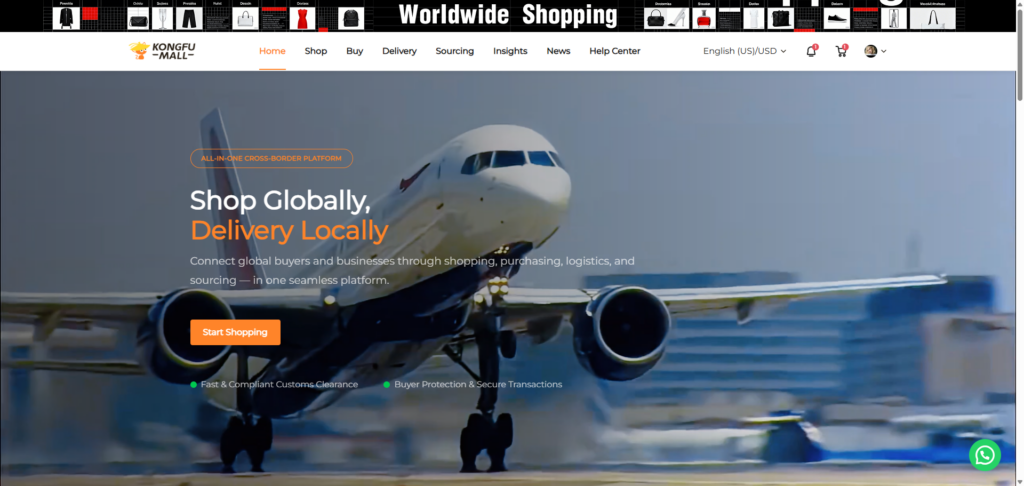
At KongfuMall, we help global buyers and small brands source products across China's domestic platforms and supply channels. If it can be bought in mainland China, we can help purchase it.
That includes:
- 1688, Taobao, and Pinduoduo sourcing
- Link-based ordering to reduce mistakes
- Warehouse receiving and processing checkpoints
- Photo inspection and verification before export
- Consolidation and combined shipping
- International forwarding with trackable steps
- China-side handling support when issues happen
The point is simple: Chinese Shopping becomes more reliable when you can control each step before international shipping.
10.2 Why this matters before you scale
Small brands don't need complexity. They need repeatable control.
A structured sourcing workflow lets you:
- Validate products faster
- Reduce bad orders
- Keep timelines realistic
- Scale restocking without chaos
That's how brands move from "small test runs" to "stable shipping cycles."
Conclusion
Chinese Shopping is not just about finding lower-cost products. For small brands, it's a speed-and-testing engine. It helps you validate demand, compare options, build supplier shortlists, and create a scalable restocking workflow. The key is not luck. The key is structure: clear item selection, warehouse checkpoints, inspection before export, and trackable shipping.
If you want help sourcing from China's domestic platforms and building a repeatable workflow before you scale, visit KongfuMall here: https://www.KongfuMall.com.