Taobao Payment Processing Fee: What Foreign Buyers Really Pay (And How to Cut It Without Risk)

Table of Contents
The Taobao payment processing fee is the moment many foreign buyers realize the "item price" is not the final number. You can do everything right-choose the correct product, message the seller, consolidate parcels-and still pay more than expected at checkout or funding time.
This guide explains what a Taobao payment processing fee actually means in real cross-border buying, why the amount changes depending on how you pay, and how to estimate your total accurately before you commit. The goal is not to chase the lowest fee at all costs. The goal is to reduce surprises while keeping your workflow predictable.
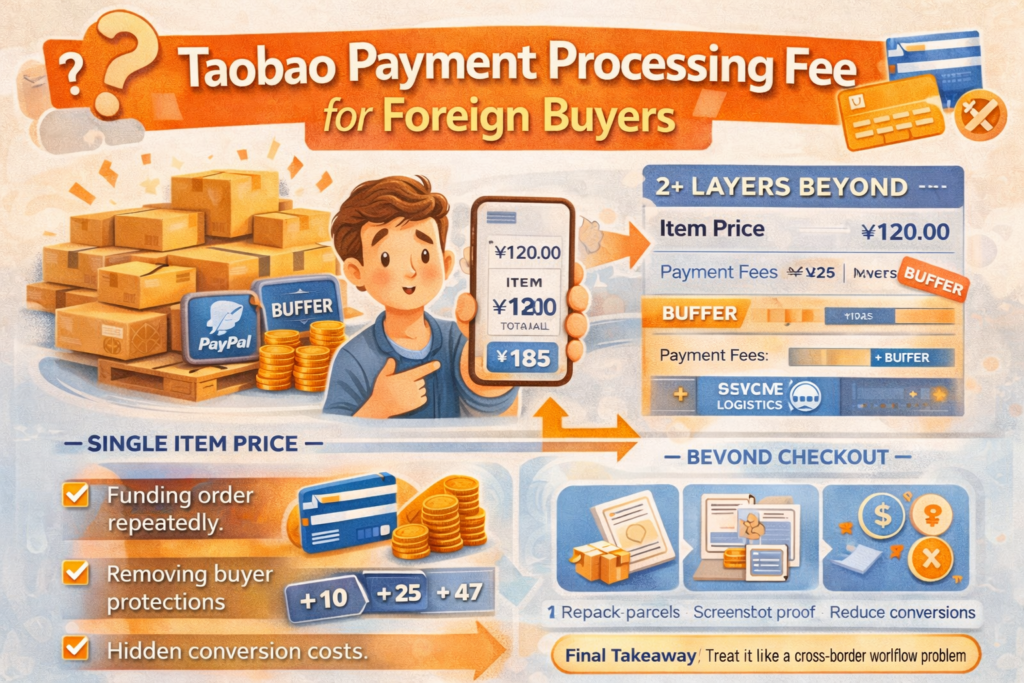
Why does the Taobao payment processing fee feel confusing for foreign buyers?
Is there one fee, or several layers of fees?
Most buyers search for "Taobao payment processing fee," expecting a single, official platform fee. In practice, overseas purchases often involve multiple fee layers that show up in different places:
- Payment provider fees (PayPal, card issuer, bank)
- Currency conversion costs (exchange-rate spread, conversion charges)
- Agent or service handling fees (if you use an agent workflow)
- Domestic shipping to a warehouse (within China)
- Warehouse services (inbound receiving, QC photos, consolidation, repacking)
- International shipping (weight and/or volumetric weight rules)
- Customs or taxes (route and destination dependent)
So the "fee" is rarely one line item. It's a set of costs that add up across the chain.
Why do two buyers pay different totals for the same Taobao item?
Two buyers can buy the same product and still see different outcomes because the cost drivers differ:
- One buyer pays in a currency that triggers conversion
- One buyer funds an agent once, another funds multiple times
- One buyer consolidates efficiently, another ships multiple parcels
- One buyer selects a faster line with higher base fees
- One buyer triggers extra verification or risk controls at payment
That is why the Taobao payment processing fee question is really a workflow question.
What is included in a real Taobao payment processing fee breakdown?
Which parts are "payment processing," and which parts are "buying workflow"?
To keep this clean, divide your cost into two buckets:
A) Payment costs (processing + FX)
- Payment provider or card network processing
- Bank/issuer foreign transaction charges (if applicable)
- Currency conversion costs (rate spread and/or conversion charges)
B) Workflow costs (service + logistics)
- Agent service/handling (if you use an agent)
- Domestic shipping to the warehouse
- Warehouse processing (inbound, QC photos, repack, consolidation)
- International shipping and delivery
When people complain about "Taobao payment processing fee," they often mix A and B, which makes the problem harder to solve.
What costs are most commonly mistaken for the Taobao payment processing fee?
Foreign buyers frequently mislabel these as "processing fees":
- Exchange-rate loss (the conversion rate you receive is not the mid-market rate)
- Multiple funding events (small payments made repeatedly can amplify total costs)
- Domestic shipping from seller to warehouse (especially with multi-seller carts)
- Warehouse optional services (QC photos, extra packing, splitting cartons)
A better mental model: the Taobao payment processing fee is the "payment friction" portion, while the rest is operational cost.
How does your payment method change the Taobao payment processing fee?
Does paying directly vs using an agent change the fee?
Yes-because it changes who you are paying, when you pay, and what proof exists.
If you pay directly on-platform (when available):
- Your payment is tied to the marketplace transaction
- Refund/return logic is more platform-controlled
- Your costs may still include FX and card/bank charges
If you fund an agent workflow:
- Your payment is tied to the agent transaction
- Your protection and disputes become more proof-based
- You may gain operational control (variant confirmation, inbound scan, QC, consolidation)
In other words, the Taobao payment processing fee becomes less about "Taobao" and more about the payment channel you use to fund the purchase.
Why do foreign buyers get stuck at checkout even if they "have a card"?
Payment success can fail for practical reasons:
- Verification prompts that require local identity or local bank flows
- Risk controls that block cross-border attempts
- Seller-side restrictions or platform restrictions
- Currency or region mismatch
That's why many overseas buyers stop thinking "How do I pay Taobao?" and start thinking "How do I make payment repeatable?"-which leads back to Taobao payment processing fee and workflow design.
How do you estimate your real total before you pay?
What is the simplest formula to predict the final number?
Use a quick worksheet like this:
- Item subtotal (Taobao prices)
- Domestic shipping (seller → warehouse)
- Service handling (if any)
- Payment costs (processing + FX)
- Warehouse services (QC, repack, consolidation if used)
- International shipping (line choice + billing rules)
- Customs/tax buffer (route dependent)
Your Taobao payment processing fee lives mainly in line (4), but you should estimate all seven lines if you want predictable outcomes.
What is a "safe buffer" to avoid surprise totals?
Because FX and logistics can vary, many experienced buyers use a buffer mindset:
- Low-risk cart (simple items, one seller): small buffer
- Multi-seller cart (several parcels): larger buffer
- High-risk items (fragile/complex variants): larger buffer
The point is not overpaying. The fact is preventing a buying plan from collapsing because your final payable amount is unexpectedly higher.
What are the most common mistakes that increase the Taobao payment processing fee?
Mistake 1: Funding the same order in multiple small payments
Multiple payments can multiply friction:
- Repeated processing events
- Repeated currency conversion
- Reconciliation confusion if something goes wrong
If you want to reduce your exposure to Taobao payment processing fees, plan your funding in fewer, larger events when possible.
Mistake 2: Letting the payment flow choose the currency conversion for you
Many payment paths offer a "helpful" conversion. It can be convenient, but it can also be expensive depending on the provider and your card/bank.
A practical control rule:
- Know what currency you are actually paying in
- Know who is converting the currency
- Avoid stacking conversions (provider conversion + bank conversion)
This is one of the fastest ways to reduce the effective Taobao payment processing fee without changing your logistics.
Mistake 3: Treating service fees like "optional fluff."
For foreign buyers, some services reduce losses that are more expensive than the fee itself:
- Variant proof (reduces wrong-item risk)
- Inbound scan proof (reduces "missing parcel" uncertainty)
- QC photos for high-risk items (reduces export-stage mistakes)
- Final carton photo (reduces disputes and packing confusion)
If you skip the wrong service, you might save a small amount now and lose far more later.
How can you reduce the impact of Taobao payment processing fees without increasing risk?
Step 1: Reduce conversion friction first
If the only thing you fix is currency conversion clarity, you often improve your total immediately.
Do these checks:
- Pay in a way that avoids double conversion
- Keep your account and payout currency consistent when possible
- Avoid repeated micro-payments for the same buying cycle
This targets the Taobao payment processing fee directly.
Step 2: Use consolidation to reduce "duplicate shipping minimums"
Even when item prices are low, shipping can dominate the final total.
Consolidation helps most when:
- You buy from multiple sellers
- You can remove unnecessary packaging
- You can repack tightly to control carton size
This does not change the Taobao payment processing fee line itself, but it reduces the "total landed cost" that people often blame on processing.
Step 3: Standardize your buying SOP so refunds are faster
Fast resolution lowers your effective cost because time and uncertainty are also costs.
A simple SOP:
- Save listing screenshot + variant selection proof
- Use a "variant bundle" note format for every item
- Confirm "what will be bought" before funding
- Use inbound proof and QC selectively
- Consolidate once, then ship
This improves outcomes when something goes wrong-so you don't "pay twice."
FAQ: Taobao payment processing fee for foreign buyers
Is the Taobao payment processing fee the same as a service fee?
Not always. Taobao payment processing fee usually describes payment friction (processing + FX). Service fees are workflow costs tied to buying support, warehouse handling, or logistics.
Why does the fee feel higher when I use PayPal?
Often, because PayPal-funded buying can include processing and currency conversion, and sometimes buyers also split payments into multiple funding events. The key is controlling conversion and consolidating payments when possible. That's how you keep the Taobao payment processing fee manageable.
Can I avoid the Taobao payment processing fee altogether?
You can reduce it, but removing it entirely is unrealistic in most cross-border flows. The practical target is to minimize conversion friction and avoid repeated processing events.
What is the "best" way to pay from a risk perspective?
The best method is the one that gives you:
- A repeatable checkout/funding path
- Clear proof and documentation
- Predictable resolution when something goes wrong
Cheapest is not always best if it increases the risk of failure.
Final takeaway: treat Taobao payment processing fee as a workflow design problem
Taobao payment processing fees become predictable when you stop treating them as mysterious platform charges and start treating them as a measurable part of your buying system. Control the conversion path, reduce repeated payments, and run a simple SOP that produces proof. When you do that, the total cost becomes easier to plan-and your buying experience becomes repeatable rather than stressful.
(And yes: if you want to rank this page, you want the exact phrase "Taobao payment processing fee" used naturally across key sections-because search intent is extremely literal here.)