One-Piece Dropshipping from China for Small Businesses: A Practical Guide

Table of Contents
One-piece dropshipping from China is a simple idea: you sell first, then source and ship each order one by one from China to your buyer. For small businesses, it's a flexible way to test products, expand your catalog fast, and avoid holding inventory-if you run it with clear rules for sourcing, checks, and shipping.
What is one-piece dropshipping from China in real life?
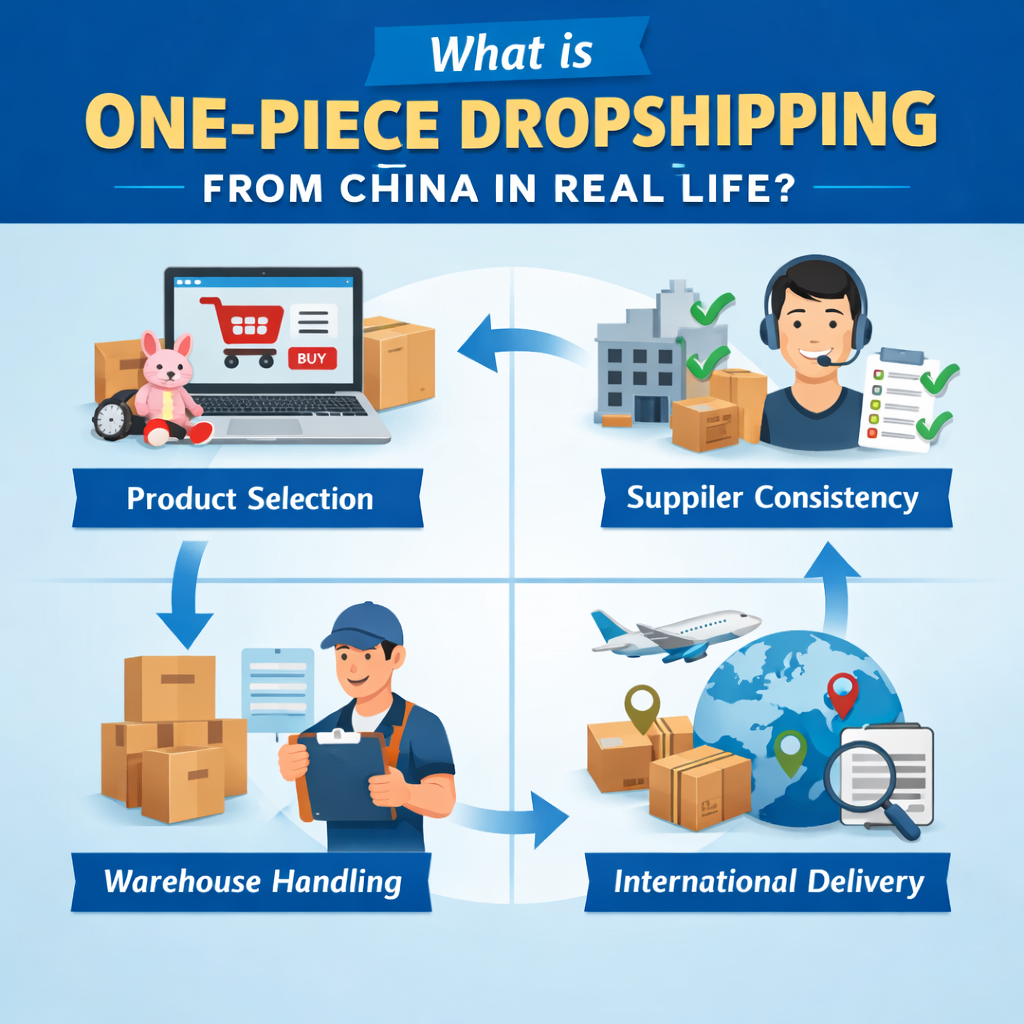
In daily operations, one-piece dropshipping from China means you manage four moving parts at the same time:
- Product selection (refund risk starts here)
- Supplier consistency (same item, same quality)
- Warehouse handling (inspection, packing, consolidation)
- International delivery (tracking and after-sales)
If any one part is weak, the business turns into customer support and disputes.
What's the biggest difference vs bulk importing?
Bulk importing is "buy stock, then sell."
One-piece dropshipping from China is "sell, then buy and ship."
That difference changes everything: cash flow, risk, speed, and how strict you must be with process.
Is one-piece dropshipping from China a good fit for small businesses?
It works best when you need flexibility and you can accept that fulfillment is an operations game.
When does it fit best?
I usually recommend one-piece dropshipping from China when you want:
- Fast testing of new niches or creatives
- A wide catalog without warehouse pressure
- Cross-border fulfillment from a single sourcing base
- A workflow that can later upgrade into bulk or overseas stocking
When is it a bad fit?
I avoid it when:
- Your customers demand very fast local delivery
- Your product requires strict compliance or heavy certification
- Your niche has high sizing risk (complex apparel)
- You can't handle returns, resends, and tracking questions
What are the main risks, and how do you reduce them?

Most problems in one-piece dropshipping from China repeat in the same patterns. I treat them like a prevention checklist.
"The item doesn't match the photos"-how do you stop this?
I reduce mismatch disputes with:
- A sample order before scaling
- A simple QC checklist per SKU (material, color, stitching, parts)
- Pre-shipment photos for sensitive items
- Clear product page descriptions (size, materials, what's included)
If a product depends on "perfect color" or "exact texture," I either avoid it or require inspection every time.
"Supplier changed the version"-how do you protect your listing?
This happens often. I keep control by:
- Saving the exact listing link and variant mapping
- Recording a "version note" (batch, material change, accessory change)
- Keeping a backup supplier for top sellers
- Updating images and descriptions fast when a version changes
"Tracking is slow or confusing"- how do you prevent support overload?
I do three things:
- Use trackable shipping routes for main countries
- Send tracking promptly after dispatch
- Publish a short tracking FAQ (typical scan delays, how updates appear)
Clear expectations reduce chargebacks and angry emails.
How do you run one-piece dropshipping from China step by step?
This is the workflow I use to keep one-piece dropshipping from China stable, even when orders increase.
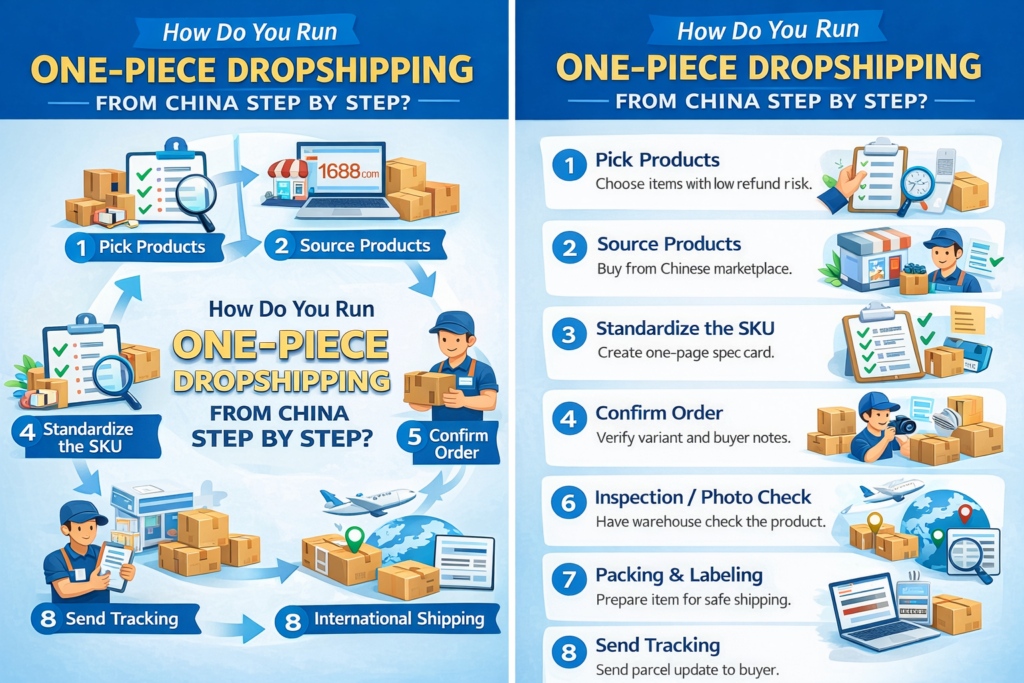
Step 1: How do you choose products that won't create refunds?
I prioritize products with:
- Simple use cases
- Low variation complexity (fewer sizes, fewer versions)
- Durable shipping behavior (less fragile, less leak-prone)
- Easy verification (can be checked by photo and measurement)
I'm cautious with products where "fit" or "feel" is the main value.
Step 2: Where do you source in China?
Common sourcing channels include:
- 1688 for factory-style supply
- Taobao for variety and fast iteration
- Pinduoduo for commodity items (but I demand stricter QC)
The platform matters less than supplier consistency and inspection discipline.
Step 3: How do you standardize a SKU before you scale?
I create a one-page "SKU card":
- Supplier link + backup link
- Variant map (color, bundle, options)
- Packaging notes (bubble wrap, box, fragile label)
- QC points (logo placement, parts count, surface finish)
- Reference photos that match the shipped item
This single document prevents wrong variants and "surprise batches."
Step 4: How do you handle fulfillment without mistakes?
My fulfillment flow is:
- Order received
- Confirm variant + notes
- Purchase from the marketplace
- Warehouse receives
- Photo check / inspection (when needed)
- Pack and label
- Book international shipping
- Send tracking
- Handle exceptions (delay, damage, wrong item)
I keep order notes short, clear, and consistent.
Should you ship direct from the seller, or use a warehouse?
For one-piece dropshipping from China, I prefer a warehouse-based flow when control matters.
When does warehouse consolidation make sense?
It's useful when:
- You want inspection before shipping
- You need stronger packaging
- You want to combine multiple items into one parcel
- You need stable record-keeping for disputes
Direct shipping can work for low-risk items, but it reduces control over QC and packing.
How can KongfuMall support one-piece dropshipping from China?
KongfuMall is built around sourcing and forwarding for global buyers. When I run one-piece dropshipping from China, I care about fewer manual steps, clearer order status, and better shipment control. A procurement-and-forwarding platform can help in these areas:
- Buy from multiple China marketplaces in one workflow
- Centralize parcels into one warehouse process
- Offer photo inspection and basic verification before shipping
- Support consolidation (combine parcels) for multi-item orders
- Provide tracking visibility and shipment records
- Enable relabeling or return/exchange marking when needed
- Offer flexible payment options for international buyers
For small teams, that's mainly about operational stability, not "more features."
What should you prepare for returns and after-sales?
Cross-border returns are complicated, so I design the store to reduce them.
What reduces disputes the fastest?
- Clear photos and "what's included" lists
- Simple size charts and measurements
- Honest expectations for shipping and tracking
- Fast support replies with a clear resolution path
When a problem happens, I focus on outcomes: resend, partial reship, or a clean refund decision-based on evidence.
FAQs

Can I start one-piece dropshipping from China without a big team?
Yes. But I keep the product range small at first. I scale only after I can fulfill cleanly, without daily chaos.
Do I need inspection for every order?
Not always. I inspect:
- New suppliers
- New products
- High refund-risk items
- Items with frequent version changes
For proven SKUs, I rely on spot checks.
Can this model later upgrade into bulk or overseas stock?
Yes. I treat one-piece dropshipping from China as a testing engine. Winners can move into bulk purchasing or overseas restocking once demand is stable.
Conclusion
One-piece dropshipping from China can be a practical model for small businesses that want flexibility without holding inventory. The real edge comes from disciplined sourcing, consistent QC rules, and a shipping workflow that produces clean tracking and fewer disputes. If you want a sourcing-and-forwarding setup that supports marketplace purchasing, inspection options, consolidation, and international delivery management, you can explore KongfuMall here:
https://www.KongfuMall.com