Taobao Refund vs 1688 Refund Rules: Key Differences

Table of Contents
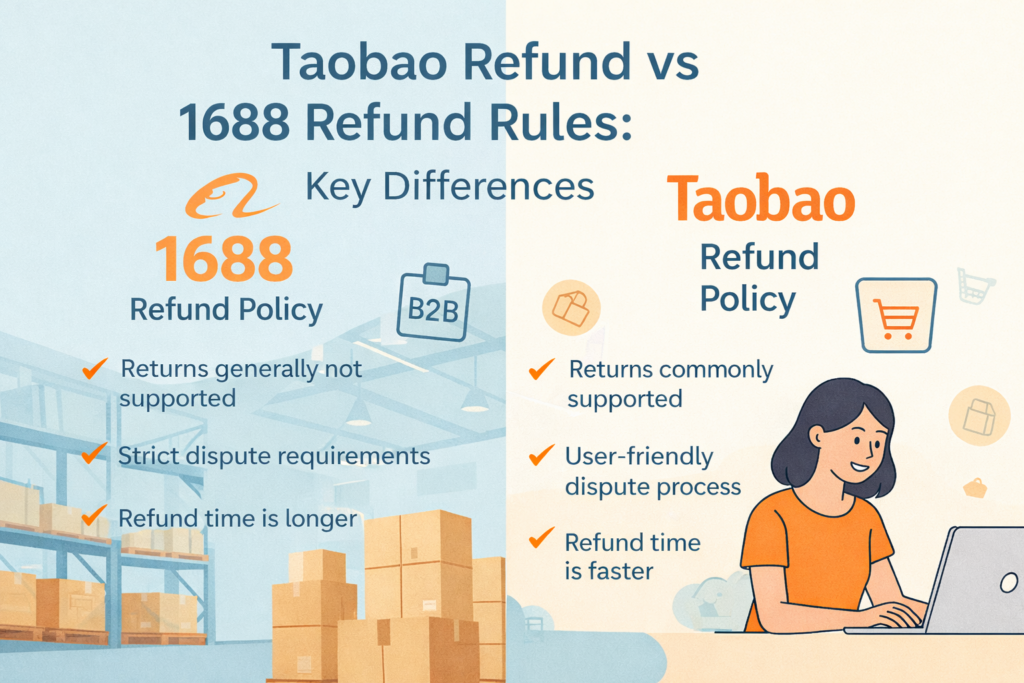
Taobao refund vs 1688 refund rules can feel confusing because these two platforms serve different kinds of transactions. Taobao is largely consumer-style shopping, while 1688 is built around wholesale and business purchasing. That single difference changes how returns are offered, how disputes are judged, and what "reasonable" evidence looks like.
1) Why do Taobao and 1688 refunds feel so different?
1.1 Are Taobao and 1688 "the same Alibaba system" for after-sales?
Not really.
They're both in Alibaba's ecosystem, but the buyer intent is different:
- Taobao: individual shoppers, small-quantity orders, more "retail-like" expectations
- 1688: sourcing, bulk buying, factory supply, custom work, repeat procurement
That's why Taobao refund vs 1688 refund rules often look similar on the surface (refund/return/dispute), but behave differently in practice.
1.2 What does this change for refunds?
It changes three things immediately:
- Default expectations (retail convenience vs negotiated terms)
- Which orders qualify for no-reason returns (where offered)
- Evidence standards (retail photos vs procurement-grade proof)
2) What is the "7-day no-reason return" rule, and does it apply to both?
2.1 Is "7-day no-reason return" a law or a platform promise?
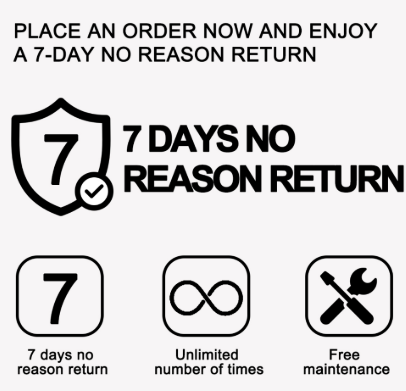
In Mainland China, the "7-day no-reason return" concept exists in consumer protection rules for many online purchases, and it includes exceptions (for example, certain customized goods, perishables, digital content, and other categories).
On platforms, you'll usually see it as a service label/commitment on eligible items rather than a blanket promise for everything.
2.2 Why this matters for Taobao refund vs 1688 refund rules
- On Taobao, many items show a clear "7-day no-reason" style service label, and the workflow is designed for consumer returns.
- On 1688, a lot of orders are bulk, negotiated, sample-to-bulk, or custom. These often fall into the "not ideal for no-reason returns" category, so the seller's after-sales terms become more central.
So Taobao refund vs 1688 refund rules isn't just "which button to click"-it's which transaction type you're in.
3) What refund types exist, and how do Taobao vs 1688 treat them?
3.1 What are the main refund paths you'll see?
Most cases fit into one of these:
- Refund before shipment (cancel / seller hasn't shipped)
- Refund after shipment (needs negotiation and/or return logistics)
- Return + refund (send back, then money returns)
- Refund without return (platform/seller agrees you keep the item)
3.2 Which one is easiest on Taobao?
For Taobao, consumer flows often make it easier to:
- apply within service windows (where offered)
- upload photos
- escalate to platform handling when negotiation stalls
Taobao's dispute handling and "refund-only" style mechanisms have been publicly discussed and adjusted over time as platforms balance buyer experience and merchant protections.
3.3 Which one is hardest on 1688?
On 1688, the hard part is usually:
- return logistics for bulk orders,
- proof standards for "not as described" in a sourcing context,
- seller-specific policies (especially for custom or production orders).
Also, 1688 has publicly moved to adjust and later remove broad "refund-only" handling in certain scenarios, shifting more cases into negotiation and credibility-based decisions.
That's a big difference in Taobao refund vs 1688 refund rules: 1688 leans more toward "business logic," not retail convenience.
4) What changed recently around "refund without return"?
4.1 Did platforms used to support "refund only" more aggressively?
Yes, and it became a major topic.
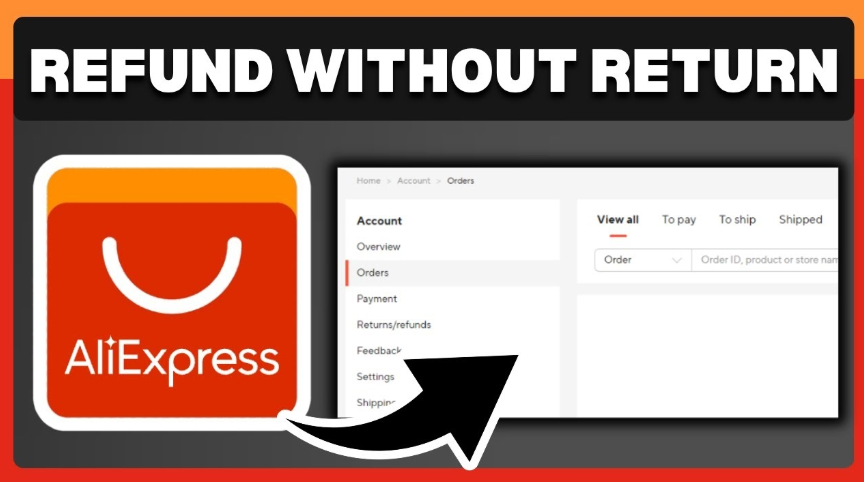
Major Chinese platforms introduced or expanded "refund only / refund without return" style handling, often tied to platform judgment and data signals.
4.2 What's the direction now?
The direction has been to reduce abuse and protect healthy merchants, meaning:
- less automatic intervention in some scenarios,
- more emphasis on evidence quality and account credibility,
- more seller negotiation first.
1688 has explicitly announced a move to fully cancel "refund only" as a broad mechanism in certain quality-related after-sales contexts, shifting the logic toward credibility-based evaluation and platform-funded compensation in eligible cases rather than forcing sellers to eat the loss.
So if you're comparing Taobao refund vs 1688 refund rules, don't assume older "instant refund" stories still match today's reality.
5) The practical differences buyers actually feel (the part you care about)
5.1 Which platform is more "button-driven"?
- Taobao: more standardized consumer steps, clearer consumer UI flows.
- 1688: more negotiation-driven, especially for wholesale/custom.
5.2 Which platform cares more about "contract-like" proof?
- Taobao: photos/videos + listing mismatch often works.
- 1688: chat records, specs, confirmations, sampling agreement matter more.
If you want to win disputes on 1688, I treat it like procurement: prove what was promised, prove what arrived, prove impact.
5.3 Which platform has higher "return friction" for overseas buyers?
Both can be tough overseas, but 1688 is usually harder because:
- bulky parcels,
- multiple SKUs,
- higher chance of "production terms" that limit returns,
- the seller expects a sourcing buyer who understands trade-offs.
This is where a sourcing/forwarding agent can change outcomes.
6) Case-by-case: what to do on Taobao vs 1688

6.1 "I changed my mind" (no quality issue)
Taobao:
If the item has a no-reason return service label, you typically follow the standard return flow within the service window and keep the item unused/complete. The legal framework also emphasizes "item kept in good condition," with exceptions for certain products.
1688:
For wholesale orders, "changed my mind" is often not persuasive unless the seller's policy clearly supports it. I'd only push this if:
- the seller explicitly promised returns for that category/order type,
- the item is still unused and easy to resell,
- the evidence is clean.
6.2 "Item not as described"
On both platforms, this is your best refund reason if you can prove it.
Evidence that actually works:
- clear unboxing photos (show label + packaging + item)
- side-by-side screenshots of listing claims vs reality
- measurement photos if size/spec matters
- short video if it's functionality-related
- chat logs if the seller promised a spec not shown on the page
6.3 "Damaged on arrival"
Here's the fastest pattern:
- Film or photo the package before you fully open it
- Show outer damage + inner protection
- Show item defect clearly
- Request a solution that matches severity:
- replacement parts
- partial refund
- return + refund (if feasible)
This kind of structured evidence reduces "he said / she said" for both Taobao and 1688.
7) Overseas reality: why agents matter for refunds
7.1 What makes refunds harder when you're not in China?
Overseas buyers face extra friction:
- domestic return address needed
- return shipping inside China must be arranged
- time zones slow negotiation
- evidence collection is harder without inspection photos
- consolidations can mix packaging, making "damage source" harder to prove
This is why Taobao refund vs 1688 refund rules becomes less about rules and more about execution quality.
7.2 How I handle it with KongfuMall workflows
If I'm using a purchasing + forwarding agent (like KongfuMall), I aim to "win before delivery":
- pre-shipment photo inspection (catch defects early)
- order notes and spec confirmation (especially 1688)
- clear labeling of SKUs before consolidation
- save all chat promises as evidence
- keep packaging photos (helps with damage or mismatch cases)
This reduces refund cases and makes disputes easier when they happen.
8) Fast checklist: Taobao refund vs 1688 refund rules

8.1 Before you file a request, ask these questions
- Is this a no-reason case or a quality/mismatch case?
- Did the listing show a service label (like no-reason return)?
- Is the order custom/bulk/production (common on 1688)?
- Do I have:
- unboxing proof?
- listing screenshots?
- chat promises (if any)?
- Can a domestic return be executed smoothly?
8.2 What I submit as "minimum evidence"
- order screenshot
- product page claim screenshot
- photos/video of the issue
- short written timeline (one screen, not an essay)
Clean proof beats long explanations.
Conclusion: what's the simplest way to remember the difference?
If you remember one thing, remember this:
- Taobao behaves like consumer retail, with more standardized after-sales flows.
- 1688 behaves like procurement: negotiated terms, heavier evidence, and more practical limits on "change of mind."
That's the real meaning of Taobao refund vs 1688 refund rules. Once you classify the transaction correctly, your refund strategy becomes obvious.
If you want help sourcing from Taobao, 1688, Pinduoduo, and basically any Mainland China platform, plus inspection photos, quality checks, consolidation, international forwarding, tracking, and simple online ordering, use KongfuMall:https://www.KongfuMall.com.